
Compassion
The Center for Positive Organizations: My Top-10 List of Research Papers
This is some stuff you should definitely check out if you´re in HR, or an (aspiring) leader – or if you want to up your game in general with regard to understanding positive organizations. All links lead you to PDFs of the respective articles.
Cameron, K. S., Bright, D., & Caza, A. (2004). Exploring the relationships between organizational virtuousness and performance. American Behavioral Scientist, 47(6), 766-790.
Cameron, K., Mora, C., Leutscher, T., & Calarco, M. (2011). Effects of positive practices on organizational effectiveness. The Journal of Applied Behavioral Science, 47(3), 266-308.
Dutton, J. E., Worline, M. C., Frost, P. J., & Lilius, J. (2006). Explaining compassion organizing. Administrative Science Quarterly, 51(1), 59-96.
Heaphy, E. D., & Dutton, J. E. (2008). Positive social interactions and the human body at work: Linking organizations and physiology. Academy of Management Review, 33(1), 137-162.
Mayer, D. M., Aquino, K., Greenbaum, R. L., & Kuenzi, M. (2012). Who displays ethical leadership, and why does it matter? An examination of antecedents and consequences of ethical leadership. Academy of Management Journal, 55(1), 151-171.
Owens, B. P., Baker, W. E., Sumpter, D. M., & Cameron, K. S. (2016). Relational energy at work: Implications for job engagement and job performance. Journal of Applied Psychology, 101(1), 35-49.
Roberts, L. M., Dutton, J. E., Spreitzer, G. M., Heaphy, E. D., & Quinn, R. E. (2005). Composing the reflected best-self portrait: Building pathways for becoming extraordinary in work organizations. Academy of Management Review, 30(4), 712-736.
Spreitzer, G. M., Kizilos, M. A., & Nason, S. W. (1997). A dimensional analysis of the relationship between psychological empowerment and effectiveness, satisfaction, and strain. Journal of Management, 23(5), 679-704.
Spreitzer, G., Sutcliffe, K., Dutton, J., Sonenshein, S., & Grant, A. M. (2005). A socially embedded model of thriving at work. Organization Science, 16(5), 537-549.
Wrzesniewski, A., & Dutton, J. E. (2001). Crafting a job: Revisioning employees as active crafters of their work. Academy of Management Review, 26(2), 179-201.

Unsplash.com – Creator: rawpixel
Positive Psychology News Digest | No. 17/2017

My favorite news and blog articles covering Positive Psychology and adjacent Topics from (roughly) the last seven days.
Fast Company: Your Positive Work Culture Might Be Making Your Team Less Productive by Belle Cooper
New York Times: You’re Too Focused on What You’re Focused On by Erica Boothby
Huffington Post: Civil Actions: Creating A Culture of Kindness at Work by Kimberly Connor
New York Magazine: A New Theory on Why People Who Exercise Lots Are So Damn Happy All the Time by Melissa Dahl
Forbes: ROK (Return On Kindness): It’s More Than Just Being Nice by Roger Dean Duncan
Washington Post: Prioritizing these three things will improve your life — and maybe even save it by Colby Itkowitz
Fast Company: You May Soon Be Able To Take A Drug To Prevent Depression by Adele Peters
New York Magazine: How Should We Talk About Amy Cuddy, Death Threats, and the Replication Crisis? by Jesse Singal
New York Magazine: Become More Resilient by Learning to Take Joy Seriously by Brad Stulberg
Guardian: Google’s Mo Gawdat: ‘Happiness is like keeping fit. You have to work out’ by Ian Tucker
Heleo: What to Do When Bad Things Happen and We Don’t Know How We Should Respond (Interview with Monica Worline), no author
Positive Psychology News Digest | No. 16/2017
My favorite news and blog articles covering Positive Psychology and adjacent Topics from (roughly) the last seven days.
Quartz: The world’s largest assessment of teenage students suggests happiness is crucial to learning by Jenny Anderson
Greater Good Science Center: Confessions of a Bad Meditator by Christine Carter
Quartz: Silicon Valley executives are hiring philosophers to teach them to question everything by Michael Coren
Psychology Today: Are You the Pursuer or the Distancer in Your Relationship? by Lisa Firestone
Washington Post: Introverts tend to be better CEOs — and other surprising traits of top-performing executives by Jena McGregor
Huffington Post: You Don’t Need Good Grades To Get An A+ In Resilience by Bowman Nixon
Psychology Today: Why Speaking Less is the Secret to Powerful Communication by Emma Seppälä
Psychology Today: 7 Must-Read Books to Change Your Life This Summer by Emma Seppälä
Quartz: Our need to feel special is making us lonely by Emma Seppälä & Peter Sims
Quartz: What is the evolutionary purpose of happiness? by Oliver Staley
BBC: Prince William says keeping a stiff upper lip can damage health, no author
Positive Psychology News Digest | No. 15/2017
My favorite news and blog articles covering Positive Psychology and adjacent Topics from (roughly) the last seven days.
Thrive Global: The Father Of Mindfulness on What Mindfulness Has Become by Drake Baer
CNN: Want to be happy and successful? Try Compassion by Jen Christensen
ScienceAlert: There’s now a brain scan to tell if you’re depressed – and what treatment is needed by Cynthia Fu
Fast Company: The Power of Pride at Facebook by Lori Goler, Janelle Gale, Brynn Harrington & Adam Grant
Psychology Today: How I Learned About the Perils of Grit by Todd Kashdan
Atlantic: Can a Difficult Childhood Enhance Cognition? by Olga Khazan
New York Times: Rude Doctors, Rude Nurses, Rude Patients by Perri Klass
New York Magazine: The Original Natural Remedy for Burnout: Nature by Brad Stulberg
Time: The Lifelong Problem With Loneliness by Elizabeth Tillinghast
Huffington Post: How to Avoid Being a Fake Positive Leader by Chris White
Positive Psychology News Digest | No. 08/2017
 My favorite news and blog articles covering Positive Psychology and adjacent topics from (roughly) the last seven days.
Forbes: Two Reasons We Fail to Be Creative by Caroline Beaton
Mindful.org: Can Mindfulness Help Us Navigate the Fourth Industrial Revolution? by Jamie Bristow
New Yorker: Why Facts Don’t Change Our Minds by Elisabeth Kolbert
Greater Good Science Center: What Would Buddha Do About the Economy? by Jenara Nerenberg
The Positive Organization: The Power of an Organizing Image by Robert Quinn
Sciencer of Us: To Navigate a Challenge, Pretend You’re Giving Advice to a Friend by Brad Stulberg
Greater Good Science Center: Can You Change Your Personality? by Jill Suttie
Heleo: Feeling Adrift? Here’s How to Strengthen Meaning in Your Life, no author
Michigan Ross: The Business Case for Compassion, no author
Heleo: Why Bringing Compassion to Work is Good for Business, no author
My new TEDx talk: “Dare to Foster Compassion in Organizations”
I´m super happy. After my official TEDx premiere at TEDx Bergen/Norway in 2014 (How to be the architect of your own fortune), as of today, my second TEDx talk is available on YouTube. It was filmed at the very first edition of TEDx EBS late in 2016. EBS University (or European Business School Oestrich-Winkel) is one of the premier business schools in Germany and, coincidentally, the place where I obtained my Ph.D.
The talk is named “Dare to Foster Compassion in Organizations”. It draws on research by luminaries such as Jane Dutton, Monica Worline, Adam Galinsky, Laura Little, Jennifer Berdahl, and the late Peter Frost (and even though they are neither mentioned nor referenced on a slide explicitly, Esa Saarinen, Adam Grant, and Robert Quinn).
I hope you will enjoy the talk! And if you do, please consider sharing the news. Thank You!
If you are interested in a (sort of…) transcript of the talk: this was published here a while ago.
Treating Yourself with Kindness: On Self-Compassion
For several decades, developing self-esteem in children and adults has been the holy grail of fostering healthy attitudes towards the self. Yet, starting in the early 1990s, criticism arose, pointing towards the absence of positive consequences of having high self-esteem, and highlighting several negative consequences, such as dismissing negative feedback or taking less responsibility for harmful actions. In an influential review article from 2003 titled Does High Self-Esteem Cause Better Performance, Interpersonal Success, Happiness, or Healthier Lifestyles?, Roy Baumeister and colleagues conclude:
We have not found evidence that boosting self-esteem (by therapeutic interventions or school programs) causes benefits. Our findings do not support continued widespread efforts to boost self-esteem in the hope that it will by itself foster improved outcomes.
In the same year, Kristin Neff from the University of Texas at Austin introduced a different kind of healthy attitude towards the self – which may be especially helpful in times of suffering, or when facing adversity: Self-compassion, rooted in the ancient Buddhist traditions of mindfulness and compassion, and Western adaptations such as Mindfulness-Based Stress Reduction (MBSR). In the words of Neff:
[…] When faced with experiences of suffering or personal failure, self-compassion entails three basic components: (a) self-kindness — extending kindness and understanding to oneself rather than harsh judgment and self-criticism, (b) common humanity — seeing one’s experiences as part of the larger human experience rather than seeing them as separating and isolating, and (c) mindfulness — holding one’s painful thoughts and feelings in balanced awareness rather than over-identifying with them.
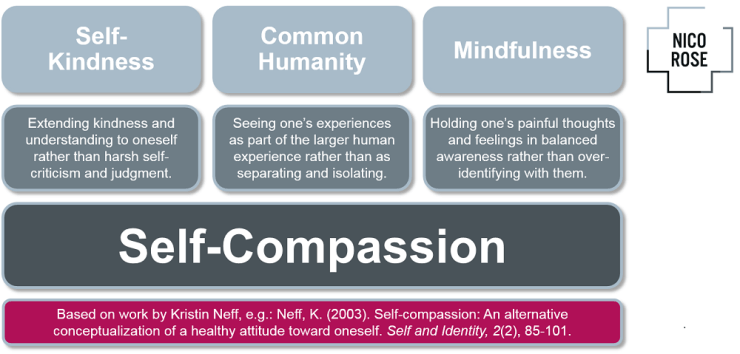
Furthermore:
[…] Self-compassion may entail many of the psychological benefits that have been associated with self-esteem, but with fewer of its pitfalls. Self-compassion represents a positive emotional stance towards oneself, in that one extends feelings of kindness and caring toward oneself. It helps to motivate productive behavior and protect against the debilitating effects of self-judgment such as depression and anxiety. Self-compassion, however, is not based on the performance evaluations of self and others, or on congruence with ideal standards. In fact, self-compassion takes the entire self-evaluation process out of the picture […].
In the meantime, self-compassion has shown to be a valuable tool for personal development and fighting symptoms such as anxiety and depression. Long-form and short-form scales for measuring self-compassion have been developed, an effective training program has been devised, and a recent meta-analysis finds that fostering self-compassion effectively helps to alleviate several psychopathologies (please see links to research papers below. You can find out more about self-compassion (e.g., free exercises and training opportunities) via Kristin Neff´s homepage.
Some of the core papers on self-compassion (linking to PDFs):
- Leary, M. R., Tate, E. B., Adams, C. E., Batts Allen, A., & Hancock, J. (2007). Self-compassion and reactions to unpleasant self-relevant events: the implications of treating oneself kindly. Journal of Personality and Social Psychology, 92(5), 887-904.
- MacBeth, A., & Gumley, A. (2012). Exploring compassion: A meta-analysis of the association between self-compassion and psychopathology. Clinical Psychology Review, 32(6), 545-552.
- Neff, K. (2003). Self-compassion: An alternative conceptualization of a healthy attitude toward oneself. Self and Identity, 2(2), 85-101.
- Neff, K. D. (2003). The development and validation of a scale to measure self-compassion. Self and Identity, 2(3), 223-250.
- Neff, K. D., & Germer, C. K. (2013). A pilot study and randomized controlled trial of the mindful self‐compassion program. Journal of Clinical Psychology, 69(1), 28-44.
- Neff, K. D., Hsieh, Y. P., & Dejitterat, K. (2005). Self-compassion, achievement goals, and coping with academic failure. Self and Identity, 4(3), 263-287.
- Neff, K. D., Kirkpatrick, K. L., & Rude, S. S. (2007). Self-compassion and adaptive psychological functioning. Journal of Research in Personality, 41(1), 139-154.
- Neff, K. D., Rude, S. S., & Kirkpatrick, K. L. (2007). An examination of self-compassion in relation to positive psychological functioning and personality traits. Journal of Research in Personality, 41(4), 908-916.
- Neff, K. D., & Vonk, R. (2009). Self‐compassion versus global self‐esteem: Two different ways of relating to oneself. Journal of Personality, 77(1), 23-50.
- Raes, F., Pommier, E., Neff, K. D., & Van Gucht, D. (2011). Construction and factorial validation of a short form of the self‐compassion scale. Clinical Psychology & Psychotherapy, 18(3), 250-255.
Positive Psychology News Digest | No. 01/2017
 My favorite news and blog articles covering Positive Psychology and adjacent topics from (roughly) the last seven days.
New York Times: The Year of Conquering Negative Thinking by Lesley Alderman
New York Magazine: Living With Purpose Yields a Longer Life and Higher Income by Drake Baer
Guardian: From Groundhog Day to … Raging Bull? – films to inspire and uplift by Peter Bradshaw
New York Magazine: Small Things to Remember to Change Your Life for the Better by Melissa Dahl
Fast Company: How To Use Brain Science To Be Your Best Self In 2017 by Lydia Dishman
Greater Good Science Center: What Does a Compassionate Workplace Look Like? by Nir Eyal & Monica Worline
Harvard Business Review: To Recover from Failure, Try Some Self-Compassion by Christopher Germer
Psychology of Wellbeing: The Law of Diminishing Returns, Applied by Jeremy McCarthy
Fast Company: 10 Science-Backed Ways To Be More Positive In 2017 by Gwen Moran
Inc: 5 things science learned about happiness last year by Jessica Stillman
Greater Good Science Center: How to Reduce Rudeness in the Workplace by Jill Suttie
Wharton Knowledge: Why Mental Bandwidth Could Explain the Psychology Behind Poverty, no author
Realize. Relate. Relieve. On Compassion in Organizations
Two weeks ago, I gave my second TEDx talk on compassion in organizations. If you are interested in the (sort of) transcript of my talk, please visit this post. The purpose of this one is just to share some photos and to congratulate the fabulous organizing team of TEDxEBS 2016. The photos were shot by Erfan Fazloomi.


 Mappalicious