Just in case you want to know: Studying at Penn feels a little bit like attending Hogwarts. Of course, there are modern buildings, too – but a lot of the facilities are just adorable. This picture shows Cohen Hall where parts of the MAPP program are hosted.

Latest Blog Posts

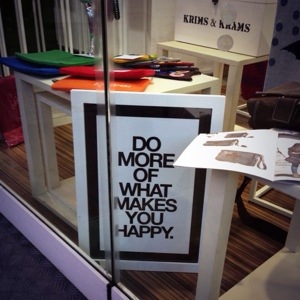
Do more of what makes you happy!
I came home to Germany from the third MAPP onsite this morning. In the afternoon, I went for a walk with my wife and the Little Guru. This is what I found in a local shop window. Wonder, for how long it has been there…
The Power of Mindfulness – or: the Bear´s Death List
 There´s a rumor in the forest: The bear has written a death list. Buzz spreads like a wildfire. Some of the animals who hear about it decide to go ask the bear about the list to soothe their uncertainty.
So, the fox goes to the bear and asks him about the list: ‘Hey bear, is it true that you have a death list?’
`Yeah.’ says the bear.
`Well… is my name on it?’
`Yeah, you’re on the list.’
The fox runs off terrified. A week later, he´s found dead next to a tree.
A few days pass. Finally, the stag plucks up some courage, comes by and asks the bear about the list.
`Hey bear, is it true that you wrote a death list?’ asks the stag.
`Yeah.’ says the bear.
‘And was the fox on that list?’
`Yes, he was.’
`Okay… so is my name on it?’
`Let me check… yeah, afraid so.’
And so the stag takes to his heels in horror. A few days later, he´s found dead by a river.
Another couple of days pass and the rabbit comes by and asks the bear about the list.
`Hey bear, is it true that you have a death list?’ asks the rabbit.
`Yeah.’ says the bear.
And was the fox on that list?’
`Yep.’
And was the stag on that list, too?’
‘Indeed, he was.’
`OK… so is my name on it?’
`Yeah, afraid so, you’re on there, too.’
So the rabbit ask:
`OK… couldn’t you… …you know… like… erase my name or something?’
And the bear says: `Sure, why not?’
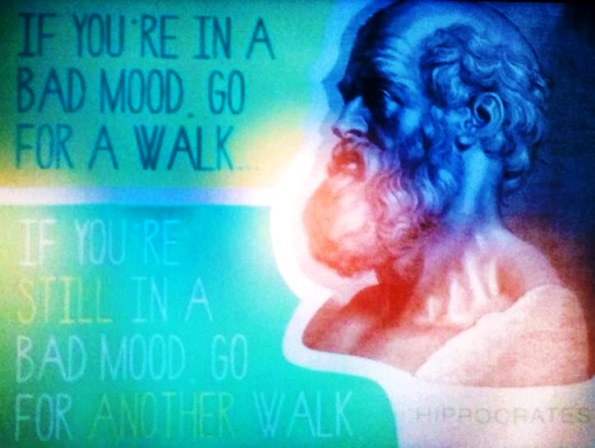
Hippocrates: If you´re in a bad Mood, go for a Walk
I´m at the third onsite of the 2013/14 MAPP program. This onsite is special because it´s the MAPP Summit: were being joined by some 60 MAPP alumni from the first eight editions of the program. Also, we´re welcoming some very interesting guest speakers. We will be joined by Art Carey from the Philadelphia Enquirer, Charlie Scudamore, who is Vice Principal at Geelong Grammar School, Ellen Langer from Harvard – and John Ratey, also from Harvard.
Right now, John Ratey is giving a presentation on the beneficial effects of physical exercise on overall well-being. He had this really nice slide that draws on Hippocrates – and I just want to share it with you…
Not the same! On being (un-)happy in the Past, Present, and Future
Are you happy? That´s a rather easy question to answer, don´t you think? Well, turns out it´s not that easy. Because it really makes a difference what you are thinking about while trying to answer this question. What are the standards you use while evaluating your ‘human condition’?

In Positive Psychology, there are (at least) three different perspectives on this issue and they center on the timeframe that is used for evaluating one´s happiness. It is literally possible to be (un-)happy in the past, present, and future – and there´s considerable evidence that these perspectives are separate from each other (albeit closely related).
When talking about ‘happiness in the past’, we usually refer to the construct of satisfaction with life which is a global cognitive evaluation of one´s life (so far). To date, it is the most widely used measure of psychological well-being.*
When talking about ‘happiness in the present’, we usually refer to what you do when actually ask somebody “How do you feel (right now)?” How much positive or negative affect do you feel in this moment? In terms of measurement, the most widely used instrument is the so-called PANAS (Positive and Negative Affect Schedule).
And finally, there´s ‘happiness in the future’ which is concerned with our optimism. How happy do you expect to be at time X in the future?
Now the interesting thing is: all three aspects will to a certain extent determine how happy you are today. And they can be tackled and improved separately (but that´s not today´s story…)
For today: if you would like to find out how you´re doing in the past, present, and future, you can take tests at Martin Seligman´s homepage. They can be found (among others) in the menu questionnaires.
*I´ve also used that one in the study that my book is based on.
Foto credit: Pamela Moore – www.istockfoto.com
The bright Side of Globalization
Those of you that have followed Mappalicious so far might have realized already that MAPP is a fulltime program – yet it consists of a mixture of onsite learning periods at Penn (3 days per month on average) and distance learning periods in between. That way, people from different walks of life and otherwise busy schedules can participate in the program without having to interrupt their careers.
Just now, I feel so grateful for having this opportunity. I´m sitting in the ‘least worst’ café of my sleepy hometown in Germany listening to word-class researchers via an online learning platform. Right now, it´s statistics which clearly is not my favorite subject – but that secondary.
Isn’t this awesome?! There´s a lot of ranting about globalization and the dark sides of internet use – but once again: Isn’t this awesome?!

Update: The Habits Of Supremely Happy People
A couple of weeks ago, I posted an article from the Huffington Post on the habits of supremely happy people.
Last week, the German edition of Huffpo was launched. The translated this article into German. It is available here.
Positive Psychology: Is it about Pleasure? Or Meaning? Or both?
The silence on Mappalicious is officially over. I´ve been travelling over the last 14 days and obviously have been too busy actually living my life in order to write about it in addition. And while doing this, I´ve made an interesting discovery: you can spend your days in New York (arguably the most exciting place on Earth) with a bunch of really nice people and a great program (Broadway musical, boat tour on the Hudson, party at one of the best rooftop bars in town etc.) – and still end up crying your eyes out in the hotel room. Just because you miss baby boy so much. True story…

Which raises a question on the nature of Positive Psychology:
Is Positive Psychology about leading a happy, pleasurable life? Or is it about leading a virtuous, meaningful life?
The answer is: both aspects are important – but if you would ask Marty Seligman, he´d say the emphasis clearly should be on cultivating strengths, virtues, and meaning. While experiencing lots of positive emotion definitley is a goal in Positive Psychology (because it just feels good to feel good; but more important: because positive emotions produce lots of beneficial ‘side effects’) they are only one element (P) of PERMA, Seligman’s theory of human flourishing.
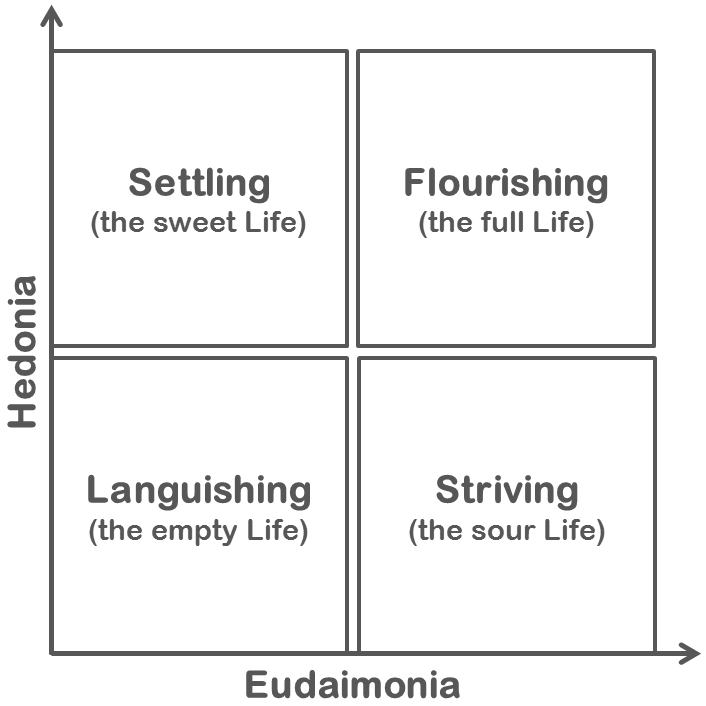
On the overarching level, it is possible to distinguish between the quest for hedonic (pleasurable) and eudaimonic (virtuous) experiences. Both clearly are important for leading a ‘full’ life, but Eudaimonia may just be a little more sustainable in the long run. When creating a 2×2 matrix with Eudaimonia on the one axis and Hedonia on the other, it will look like this:
-
When a human being experiences high levels of positive emotion and the presence of meaning, worthwhile goals, connection to other human beings etc., this can be characterized as ‘the full life’ or ‘Flourishing’ in the official diction.
-
The absence of both dimensions is called ‘the empty Life’ or ‘Languishing’ – a condition that is closely tied with depression.
-
If someone is high on the hedonic dimension but relatively low on Eudaimonia, I like to call it ‘the sweet life’ (‘Settling’ in the official lingo). By way of example, imagine the prototypical billionaire heir that squanders his family´s money on the French Riviera. It´ll surely be pleasurable but may also seem somewhat shallow.
-
On the other hand, when there´s a considerable lack of Hedonia, this condition can be termed ‘the sour life’ or ‘Striving’ in official Positive Psychology speak. You might want to imagine the epitome of an old unmarried lady that spends all of her time and money on ‘good causes’ but forgets herself on the way. It is admirable but may also seem a little ‘anemic’.
If you´d like to learn more: I´ve written an article in a coaching magazine on that topic about a year ago. It´s in German unfortunately – but I know that many German-speaking people are reading this blog, too…
Social Media and Wellbeing – or: Can your iPhone tell if you´re depressed?
For a moment, please imagine that you have had an episode of depression at an earlier point in your life. Obviously, you would not want anything of that to return anytime soon. Unfortunately, that´s just not an easy thing to do. Relapse rates for depression are rather high – thus, there is a considerable probability of experiencing at least one other episode once who been there for the first time.
Now imagine there´s someone that could give you an early warning. Someone that would be able to detect and interpret all those little behavioral signals that typically occur when a person slips in into depression. This someone would also automatically notify your doctor so she can catch up with you. Sounds like a dream of the future? Well, maybe not. What if your smartphone could understand what you are saying all day long – and then infer from your words that you are currently talking like somebody who is depressed?
Enter several researchers from the University of Pennsylvania, of whom one is Johannes Eichstaedt (who was in the MAPP program three years ago). They analyzed 700 million words and phrases collected from Facebook messages of 75,000 volunteers, who also took standard personality tests. What they´ve found is pretty amazing: the usage of certain (groups of) words on Facebook can be highly predictive of certain aspects of our personality, but also other variables like gender or age. So while there are a lot words that basically everybody uses to the same extent, there are specific words or sentences that on average tend to occur more often when, e.g., you´re a woman (as opposed to a man), or 35 years old (as opposed to 15), or extroverted (as opposed to introverted), or displaying high levels of Neuroticism (as opposed to Emotional Stability).

Have a look at the image (click to enlarge), especially at the grey, blue, and red wordles at the center of the word clouds (those that are surrounded by the greenish ones). They can tell us something on the language(s) of a) extroversion, b) introversion, c) neuroticism, and d) emotional stability. The size of each word will tell you something on the predictive power pertaining to the variable in question.* By way of example, the use of the word ‘internet’ is a better predictor of being introverted than the use of ‘comic’. Additionally, the color will tell you how often that word is used (relatively; grey = not that often; blue: often; red = very often).
Now isn´t that cool? But…you might ask: So what?
The ‘So what?’ leads us back to beginning of this post: if there is a typical ‘language of neuroticism’, there might also be a typical ‘language of depression’ – since displaying, e.g., a high level of neuroticism is correlated with the prevalence of depression. Or there might be a typical ‘language of mania’, or a ‘language of schizophrenia’ etc.
Now suppose there were an app on your smartphone that – at certain intervals over the day – switched on and took sound files of whatever you´re doing at a specific moment. It would surely pick up a lot of your conversations. By way of speech recognition (and prior, being fed with the algorithms that the abovementioned research is based on), your smartphone could detect if, over the course of time, your use of language changes from a ‘language of (relative) mental health’ to a ‘language of relative mental illness (perhaps, the app could also analyze whatever you´ve written on Facebook, Twitter and e-mails on a specific day). And if that were the case, the app would report this change back to you (or your doctor) as a means of early recognition. Wouldn’t that be really, really beneficial to a lot of people?
Now to date, this is a dream of future. But all the ingredients are there!
If you would like to learn more on this research, please click here for the original research paper. Also, there is a lot of cool stuff coming up in the near future – so you might want to check out the website of the World Well-Being Project.
*Please note that this is correlational research – so it is not appropriate to make any causal inferences. For instance, frequently using the word ‘party’ will not make you more extroverted. Rather, it can be likened to a ‘side effect’ of already being extroverted.
I went to MAPP and all I got was this…
 …deck of cards! No, that´s not true obviously.
Today has been the first day of MAPP´s second onsite learning period – and actually, every student did in fact get a deck of cards as a gift from Barry Schwartz, who is this weekend´s guest lecturer. It was created by Brooke Allen and is supposed to help us to create a “robust Philosophy of Life” by answering 54 questions on life, meaning, and sense of purpose. I have yet to try them out – but I will let you know how it all worked out.

As before, I do feel I´m not yet ready to write on what we´ve learned today. I´m still in the process of digesting everything that has been said. Instead, I´m going to build on a recent article that summarizes the most important ideas from Schwartz´s book ‘The Paradox of Choice’. In that post, I described why Schwartz believes that having too many choices can make us miserable.
The question is: is that really true? After all, we live in a free market economy and that´s supposed to make us happier than experiencing lots of constraints, e.g., like it used to be in most (former) communist countries. A powerful piece of evidence comes from the Amish people, a religious community with German heritage of about 250.000 people that pursue a simple, non-materialistic lifestyle – basically they ignore all kinds of modern comforts like cars, telephones, and electricity in general. While this may sound not too inviting there may be some interesting upsides this kind of lifestyle. Notably, the depression rate of the Amish is only a fraction of the overall U.S. population. One explanation for this might be the very close social ties that the Amish are embedded in. But yet another hypothesis can be drawn from the work of Schwartz: the Amish only have to make a fraction of the choices that we have to make in our lives. They do not have to worry about which clothes to wear because basically there is a rule. The do not have to worry about which car to buy because it is simply not allowed to own a car. In most orders, it´s not allowed to maintain a website – and so on.
At the end of the day, that may not seem very attractive to most ‘modern’ people. Good news is: we do not have to copy them. But we should be aware of the principle behind those actions: choosing not choose can be a potent way of improving our lives. Setting rules, standards, and default modes is be a powerful trajectory towards increased mental health.
How does this relate to your life?
 Mappalicious