Feedback on Optimal Human Functioning: The Reflected Best Self Exercise™

Nico Rose | Jane Dutton

Nico & Jane Dutton at Ross School of Business

In mid-December, I got to spend a week in Ann Arbor at the Ross School of Business, taking part in an open enrollment course called The Positive Leader: Deep Change and Organizational Transformation. It´s a formidable tour de force through the most important frameworks and applications of Positive Organizational Scholarship (POS). I´m going to write some more about my experiences over the upcoming weeks.

Today, I´d like to share with you the Reflected Best Self Exercise™, a powerful tool that helps people to learn more about their individual strengths and what they´re like when they display some form of peak performance (from the vantage point of other people). In short, the exercise is about asking a group of people to supply you with stories of times when they perceived you to be at your best. In other words, you ask people for feedback about your strengths and capacity for peak performance – and only about that.

What other people appreciate about us tends to appreciate over time.

What´s so special about receiving only positive feedback once in a while? It´s extraordinary because we typicially hear mixed messages, e.g., as part of a performance appraisal at work. What´s the point? Rick Hanson, author of “Hardwiring Happiness”, likes to say “our mind has velcro tapes for negative and teflon layers for positive information.” Even if the usual feedback we receive is mostly positive, our brain drives us to ponder almost exclusivley on the negative (= potentially harmful) information. This mode of processing has actually helped us to survive as a species over thousands of years (please see Bad is Stronger than Good for more background) – but it also keeps us from truly taking in any positive information, unless we explicitly allow ourselves to focus on that side of the spectrum, so we can learn and grow based on who we are when we´re at our best.

Learning from what´s already (more than) good

How are we supposed to improve and grow when we´re not focusing on our weaknesses? As the saying goes, “where attention goes, energy flows” (and results show). Learning about who we are when we are at our best helps us to:

The last bullet point seems especially important to me as it points towards the so-called Pygmalion Effect, the phenomenon whereby higher expectations by others lead to an increase in actual performance. When we ask people to reflect on our positive sides, we actually help them to perceive what Jane Dutton calls the “zone of possibility”, a reservoir of untapped resources and growth potential. Via authentically pointing us towards these strengths and capabilities, they help us to become more than we currently are. This is the true nature of appreciation. The typical connotation of “to appreciate” points towards a strong form of liking. But it also means to grow in value. What other people appreciate about us tends to appreciate over time.
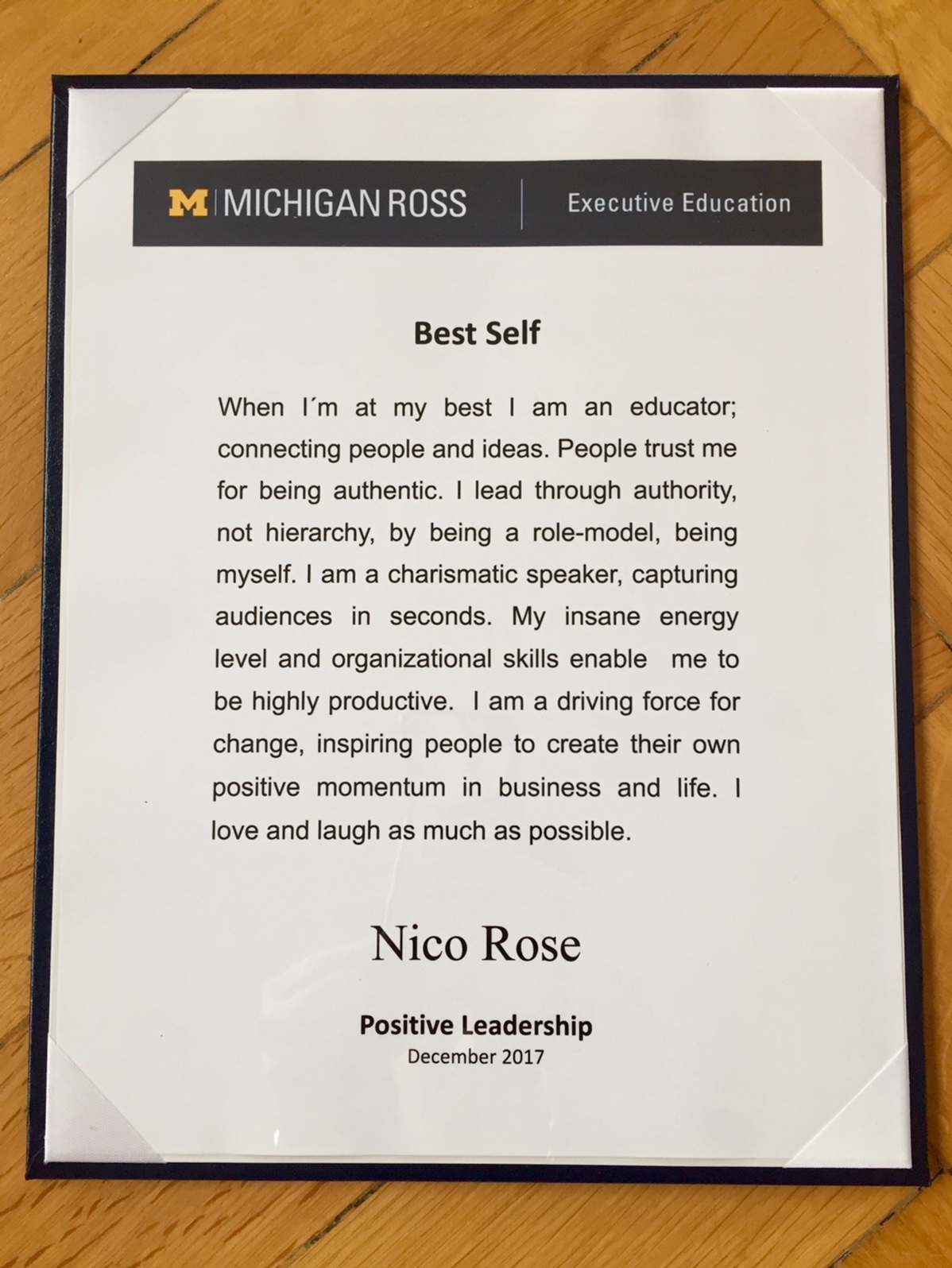
Reflected Best Self - Nico Rose

How does the Reflected Best Self Exercise™ work?

  1. Collect stories from a variety of people inside and outside of your work. You should receive feedback from at least 10 people. By gathering input from a variety of sources, such as family members, past and present colleagues, friends, teachers etc., you can develop a broader understanding of yourself. Specifically, ask them to supply you with short stories of episodes when they perceived you to “be at your best”. Ask for specific and tangible examples, not general impressions.
  2. Recognize patterns and common themes: After gathering those stories, read through them carefully, allowing yourself to take and savor in the positive content. Then, go through them several times, making mark-ups and remarks with a pen. The goal is to search for common themes and recurring patterns within the different stories. These commonalities will serve as the base for your “Best Self Description”.
  3. Then, write a description of yourself that summarizes and distills the accumulated information. The description should weave themes from the feedback into a concise “medley” of who you are at your best. This portrait is not meant to be a complete psychological profile. Rather, it should be an illuminating image you can use as a reminder of your contributions and as a guide for future action (you can see the result of my own process in the picture on the right).
  4. Redesign your job (optional): Now that you you have crafted your “Best Self Description”, what are you supposed to with it? To start, it´s a very good idea to hang a print-out in some corner of your office so as to have an easily accessible reminder of you can be, for those times when things become stressful (and they always do in large organizations). This will help you to keep your composure and look beyond the constraints of the current situation. In the long run, it´s definitely useful to think about the larger implications of your best self:
    • To what extent is your current job playing to your strengths?
    • Can you change your current task and responsibilities so as to better reflect your best self? (please see: Job Crafting)
    • Or should you maybe think about a change of careers to realize your full potential?

I hope you will have tons of fun and insightful moments with this framework; I surely did. By the way, I´ve found out earlier this also works perfectly using social media channels such as Facebook and LinkedIn. You can read my account of this “experiment” here.

Resources

You can find a full description of the Reflected Best Self Exercise™, its application, and the underlying research via these articles:

You´ll find lots of resources with regard to the Reflected Best Self Exercise™ on the website of the the Center for Positive Organizations at Ross School of Business.

The Center for Positive Organizations: My Top-10 List of Research Papers

This is some stuff you should definitely check out if you´re in HR, or an (aspiring) leader – or if you want to up your game in general with regard to understanding positive organizations. All links lead you to PDFs of the respective articles.

Cameron, K. S., Bright, D., & Caza, A. (2004). Exploring the relationships between organizational virtuousness and performance. American Behavioral Scientist, 47(6), 766-790.

Cameron, K., Mora, C., Leutscher, T., & Calarco, M. (2011). Effects of positive practices on organizational effectiveness. The Journal of Applied Behavioral Science, 47(3), 266-308.

Dutton, J. E., Worline, M. C., Frost, P. J., & Lilius, J. (2006). Explaining compassion organizing. Administrative Science Quarterly, 51(1), 59-96.

Heaphy, E. D., & Dutton, J. E. (2008). Positive social interactions and the human body at work: Linking organizations and physiology. Academy of Management Review, 33(1), 137-162.

Mayer, D. M., Aquino, K., Greenbaum, R. L., & Kuenzi, M. (2012). Who displays ethical leadership, and why does it matter? An examination of antecedents and consequences of ethical leadership. Academy of Management Journal, 55(1), 151-171.

Owens, B. P., Baker, W. E., Sumpter, D. M., & Cameron, K. S. (2016). Relational energy at work: Implications for job engagement and job performance. Journal of Applied Psychology, 101(1), 35-49.

Roberts, L. M., Dutton, J. E., Spreitzer, G. M., Heaphy, E. D., & Quinn, R. E. (2005). Composing the reflected best-self portrait: Building pathways for becoming extraordinary in work organizations. Academy of Management Review, 30(4), 712-736.

Spreitzer, G. M., Kizilos, M. A., & Nason, S. W. (1997). A dimensional analysis of the relationship between psychological empowerment and effectiveness, satisfaction, and strain. Journal of Management, 23(5), 679-704.

Spreitzer, G., Sutcliffe, K., Dutton, J., Sonenshein, S., & Grant, A. M. (2005). A socially embedded model of thriving at work. Organization Science, 16(5), 537-549.

Wrzesniewski, A., & Dutton, J. E. (2001). Crafting a job: Revisioning employees as active crafters of their work. Academy of Management Review, 26(2), 179-201.

rawpixel-com-250087

Unsplash.com – Creator: rawpixel


The Center for Positive Organizations at University of Michigan: a Book List

Kim Cameron | Nico RoseI´m the luckiest guy in the world. I get to spend the week at University of Michigan in Ann Arbor, more precisely: the Ross of Business. Part of the Ross School is the Center for Positive Organizations – which without exaggeration can be described as the global focal point for research and application(s) of Positive Psychology in business (Positive Organizational Scholarship). It´s home to POS luminaries such as Kim Cameron, Jane Dutton, and Robert Quinn. Additionally, some of the big shots in the field have completed their Ph.D. studies here, among them Adam Grant and Amy Wrzesniewski.

I´m going to provide an overview of what I´ve learned here at a later point in time. For today, I´d like to provide a book list of works that been crafted by faculty of  the Center for Positive Organizations. After is, Christmas is coming up soon – and you might still be looking for something for your loved ones (or yourself)…

Also, watch out for Wayne Bakers upcoming book “Just Ask”…

Martin Seligman receives APA‘s Award for Lifetime Contributions to Psychology

I haven’t posted something new on Mappalicious for quite some time – but this is a piece of great news: Martin Seligman, co-founder and spiritus rector of Positive Psychology, has recently been awarded with the American Psychological Association’s “Award for Lifetime Contributions to Psychology”, APA’s highest award – joining luminaries such as Daniel Kahneman and Albert Bandura. Congratulations, Marty!

Mappsterview No. 8: Dan Lerner introduces “U Thrive”

dan_lernerFor this Mappsterview, I´m happy to interview Dan Lerner who attended Penn´s Master of Positive Psychology program two years before me. He was a teaching assistant in my MAPP cohort and I remember him mostly for his high level of energy – and giving me decent grades on my theory papers despite my crappy German-English phrasing. Today, his book U Thrive is published, co-authored with Alan Schlechter.

Dan, please introduce yourself briefly.

Hi there! I am Dan Lerner, MAPP 7. One of the many Dans who have been fortunate enough to attend the program (although hardly the most talented…or tallest…or for that matter the oldest), I am now a clinical instructor at NYU teaching “The Science of Happiness” to over 1000 students each year. I am also super lucky to remain on staff at MAPP as an assistant instructor.

What did you do before joining the MAPP program at Penn?

Oh! There was life before MAPP? I had totally forgotten. I seem to recall a decade in the music business as a talent agent for opera singers, there may have been some coaching in there as well…and…that’s right…before MAPP I enjoyed a life free of theory papers.

What got you interested in Positive Psychology in the first place?

During my ten years in the music business, I saw two very different types of artists. There were those who were happy onstage and off. They loved to perform, they adored their colleagues, and they found joy in the music, but it was clear that family, faith, or meaning came first. As one of the most successful singers in the world mused when I asked how he kept the nerves at bay, “I care deeply about what I offer in performance, but if I crack a note, forget a line, or trip and fall onstage, I still get to go home to my kids and hang with my friends. And you know what? None of them care about the performance: they love me, I love them, and that’s what counts.”

Yet many artists seemed profoundly unhappy despite great success in the music industry. During my first year on the job, I watched a renowned singer give a stunning performance in front of a sold-out crowd of thousands. With deafening applause and screaming fans pleading for an encore, her radiant smile dropped into a mask of annoyance the moment she walked offstage as she looked at me, put her hands on her hips, and groaned, “Jesus, why do I even do this?” I regularly received tearful phone calls from artists who missed their families, and angry calls from others who—despite ever-growing success and fame—were clearly frustrated with their lives.

Excellence and well-being, I discovered, did not necessarily go hand in hand. It got to a point where I had seen too many people with extraordinary talent either suffer or simply burning out before they could fully explore and realize their potential. So I left.

My first stop was to dive into performance psychology. I was incredibly fortunate to meet and study with Dr. Nate Zinsser, the Director of The Center for Enhanced Performance at the United State Military Academy at West Point. Nate’s clear interest in athletes who enjoyed success not only on the field but off was reflected in the syllabus that he assigned, for it included Marty’s Learned Optimism and Mike Csíkszentmihályi´s Flow. When I realized that there was a way to study well-being and its role in expert development, I was hooked. I immediately applied to MAPP, and of course, was rejected just as swiftly. Let’s just say that a fair amount of groveling goes a long way.

u_thriveTogether with Alan Schlechter (whose last name ironically means “worse” in German…), you´ve now written a book that aims at helping undergrads thrive throughout their college career. Please tell me about that project.

Almost 4,000,000 students entered the undergrad ranks in the United States last year. These students will sleep less then ever before, eat more poorly, and spend less time with friends than anytime in college history. By the end of their first year, 30% of freshman will have dropped out. A recent study by the Gallup organization of 16,760 students found that in the past twelve months, 79.1 percent of them had been “exhausted (not from physical activity),” 59.6 percent felt “very sad,” 45 percent found that “things were hopeless,” and 31.3 percent had been “so depressed that it was difficult to function.”

Based on these numbers, for many college students, what was anticipated to be the “four best four years of their life” have begun to feel more like their worst.

College should be about thriving, not just surviving, and for the past five years, Alan and I have taught “The Science of Happiness” to our undergraduates at NYU with one sole intention: To help students thrive in college and beyond. “U Thrive: How to Succeed in College (and Life)” is our attempt to help share this information with students across the county. As a child and adolescent psychiatrist, Alan has spent more than a decade helping young adults deal with their challenges, while I have focused for roughly the same amount of time on bringing well-being into the process of human development and the realization of individual potential. He’s red cape, I’m green, and together it is with these complementary skills that we strive to address both the tough times and the incredible opportunities that abound during a student’s time in college, sharing the theory, science, and application of thriving.

From stress to relationships, willpower to mental health, purpose to passion, and beyond, we weave the most pertinent empirical findings into engaging stories and practical application, crafting experiential learning assignments to both inform and transform our students lives. We help them learn how they can turn their fear into excitement and their anxiety into possibility.

U Thrive is the book that we wish we had in college. U Thrive helps students understand how to develop mindsets of growth, success, and resilience so that they can nurture inspiration instead of fear. We know that they will have a better chance to make the most of their four years if they understand what willpower really is, how it works, how they can strengthen it, and when it is most likely to be tested. We cover how positive emotions help them be more creative and feel more relaxed, and allow them to perform better under pressure, be it onstage, in class, on the field, or on a date. We want them to be able to distinguish bad stress from good stress, learn how to set a routine that encourages more of the latter and less of the former, know when to turn to friends and family for support, and recognize when a visit to campus mental health services may be the way to go.

Rough roommates? It’s in there. How to cultivate healthy and awesome relationships? Yes. Is the Freshman Fifteen real? What happens when you take a fifteen-minute nap while studying? Or a fifteen-minute walk? What does research show that fifteen minutes of breathing practice a day do for your grades, your mood, your relationship, and/or your focus? And what are the steps to develop these routines during the most unstructured time of their lives to date?

Our dream (and no, not ((just)) for financial reasons) is to get this book into the hands of every college bound student/freshman so that they can deal with the challenges and make the most of their opportunities on campus.

If you could send a part of the book to a younger version of yourself, while you were in college – what part would that be? And why?

It would probably be the cover, so that I could show it to my parents in an attempt to convince them that I wasn’t actually partying my life away and that I did have a somewhat promising future.

But if we’re being honest, it would be the final section, Positively Excellent. I quit a very successful career in music to live alone in a shack on a Caribbean island, before founding (and then quitting) another very successful business in music, before bartending at some huge NYC spots, before finally going back to school and finding my way in teaching and speaking. (You can see why my parents were so confused.) Basically I quit a lot of stuff right when I was poised to have huge careers in each. I can’t lie, it was stressful to have busted my butt in each area, working 80+ hours/week at each stop, only to quit and seemingly begin again.

The final section addresses the challenges of pursuing what our hearts tell us that we should. Not only how to do it, but how to do it well, and how to do it with well-being. We discuss meaning, expert development, and the role (and science ) of passion. Perhaps most importantly, this section attempts to make clear to young people that they have a choice, that their future lies very much in their hands, and that so many paths to great success and  well-being demands that they live as individuals. I think that having known this before I embarked on my journey would have helped me stress a lot less and accept the path that I had chosen.

Hopefully now that I have done the research and written on the above, quitting and starting over the next time will be a lot easier. 🙂

From “Made to Stick” by the Heath brothers, I´ve learned that it´s really helpful to sell stuff by using insightful analogies. The script for “Alien” supposedly was pitched as “Jaws on a spaceship”. What´s the analogy for your book?

“The Shining for toddlers”?  “An underwater version of The Death of Ivan Illych”? Look, people make fun of the fact that so many studies are done on college sophomores so who the hell else do the studies then apply to, but it was perfect for us and our readers. They’re college students, they stand to benefit from knowing about their peers, and that’s what we are striving to do, so the analogy is simple: Positive psychology for college students. It’s not exactly as sticky as “An all panda bear version of The Great Gatsby”, but it’s pretty much spot on.

Thanks a lot, Dan – and best of luck with your book!

4 Ways to build a Human Company in the Age of Machines [TED Talk]

Description of Ted Leberecht´s talk:

In the face of artificial intelligence and machine learning, we need a new radical humanism, says Tim Leberecht. For the self-described “business romantic,” this means designing organizations and workplaces that celebrate authenticity instead of efficiency and questions instead of answers. Leberecht proposes four (admittedly subjective) principles for building beautiful organizations.

My new TEDx talk: “Dare to Foster Compassion in Organizations”

I´m super happy. After my official TEDx premiere at TEDx Bergen/Norway in 2014 (How to be the architect of your own fortune), as of today, my second TEDx talk is available on YouTube. It was filmed at the very first edition of TEDx EBS late in 2016. EBS University (or European Business School Oestrich-Winkel) is one of the premier business schools in Germany and, coincidentally, the place where I obtained my Ph.D.

The talk is named “Dare to Foster Compassion in Organizations”. It draws on research by luminaries such as Jane Dutton, Monica Worline, Adam Galinsky, Laura Little, Jennifer Berdahl, and the late Peter Frost (and even though they are neither mentioned nor referenced on a slide explicitly, Esa Saarinen, Adam Grant, and Robert Quinn).

I hope you will enjoy the talk! And if you do, please consider sharing the news. Thank You!

If you are interested in a (sort of…) transcript of the talk: this was published here a while ago.

3 Questions for Emily Esfahani Smith, Author of “The Power of Meaning: Crafting a Life That Matters”

emily_esfahani_smithEmily Esfahani Smith is a writer and fellow Penn MAPP alum. She writes about culture, relationships, and psychology. Her writing has appeared in the Wall Street Journal, New York Times, The Atlantic, and other publications. A few days ago her first book, The Power of Meaning: Crafting a Life That Matters, was published. Today, she took some time to talk about her work on Mappalicious.

Emily, in your book, you propose there are four pillars of a meaningful life: belonging, purpose, transcendence, and storytelling. I´ve already come across the first three while studying Positive Psychology, the last one seems to be a very unique angle. So what´s the story with storytelling?

When people say their lives are meaningful, it’s because three conditions have been satisfied, according to psychologists—they feel their lives matter and have worth; they feel their lives are driven by a sense of purpose; and they believe their lives are coherent or comprehensible. Storytelling relates to that third prong of meaning, coherence. Storytelling is the act of taking our disparate experiences and weaving them into a whole. Rather than seeing their experiences as random or disconnected, people who feel their lives are meaningful see their experiences as part of a narrative that explains who they are and how they got to be that way. Another word for storytelling is sense-making—when we tell stories, we’re really trying to make sense of our experiences.

One of the people I interviewed for my book, for example, told me that experiencing adversity as a child ultimately made him a more compassionate person—that’s the story he tells about his adversity; that’s how he makes sense of it. But storytelling isn’t just about understanding ourselves more deeply, it’s also about understanding others. When we watch movies or read novels or listen to a friend’s story, we’re ultimately gaining more wisdom and perspective about what it means to be human.

power_meaning_esfahaniIn my day job, I´m heading a department in a multinational corporation. Therefore, I take special interest in the application of Positive Psychology in organizations. Do those four pillars you describe also apply to meaning in work – or are there additional aspects leaders should consider when thinking about their employees´ experience?

One of the most exciting trends of the last few decades has been the emergence of what I call “cultures of meaning” in institutions like corporations. Many companies are actively building cultures of meaning for their consumers and employees by relying on the four pillars of meaning.

A great example is the apparel brand Life Is Good, which sees its purpose as spreading hope and optimism around the world. It does this with its apparel, which has the words Life Is Good emblazoned on it. Many consumers have written to the company saying that its elevating message has helped them get through adversities and tragedies like cancer and losing loved ones. The leaders at Life Is Good have shared those stories with their employees, to show them that their work is making a positive impact on others. Life Is Good also has a non-profit arm that helps children facing adversities. When I spoke to several of the employees at the company—from a receptionist to a designer—they all told me that they are driven by the good that their company is doing in the world. So here, I see Life Is Good relying on the pillars of purpose and storytelling to create cultures of meaning.

It’s important for leaders to be aware of whether employees are experiencing their work as meaningful. Nothing engages or motivates employees quite like meaningful work—and research by Adam Grant suggests that doing meaningful work makes employees more productive, too (Adam´s interview on Mappalicious can be found here).

I feel my life is already pretty meaningful. I´m happily married and have two beautiful kids. Additionally, I can spend a lot of my time working on things I deeply care about and help other people. But I´m not so sure about the storytelling part. What are some steps I could take to enhance my experience of meaning in life via this pillar?

Storytelling requires reflection. I would recommend setting aside some time—maybe 15 minutes a day a few times a week—to either think or write about your life story. That may sound daunting or vague, but here are some specific things you can reflect on during that time.

1. Try dividing your life into chapters. How many chapters are there? What is the title or theme of each chapter? What makes each chapter unique? What chapters are yet to come? How many future chapters are there? What do you want the final chapter to say?

2. When you look back on your life, what were the turning points? What were the high points and the low points? How did those experiences change you? What did you learn from them? Are you still working to process them?

3. Reflect on the places in your life that played a formative role in your development—like where you grew up, perhaps, or where you went to college, or where you first met your husband or wife. While you’re thinking about these places, ask yourself: why were your experiences there so meaningful? How did they change you? What would your life have been life if you had grown up somewhere else or gone to a different school? What does it feel like being back in those places?

I’d like to add that storytelling is a pillar that takes work—sometimes we have to go over and over an experience hundreds of time before we can begin to make sense of it and understand how it fits into the broader arc of our lives. But it’s ultimately worth it, because that sense-making process brings us wisdom, resolution, and even a measure of peace.

Thank you, Emily, and best of luck with your book!

***********

For more info on Emily and her work, please check out her The Psychology Podcast, or recent features on The Psychology Podcast, Heleo and Virgin.