Positive Interventions: An Angel came down

Penn - SnowOne noble duty of positive psychology is to develop positive interventions, intentional exercises that help to build positive phenomena, such as positive mood, character strength, relationships, or meaning in life. I believe that a very simple positive intervention is to listen to right kind of music. So, since Christmas is only about two weeks away, I´m going to share with you my favorite Christmas song. It´s “An Angel came down” from the first album by Trans-Siberian Orchestra, a side project of one of my favorite bands of all time, the mighty glorious Savatage.

For some reason, I can hardly listen to this song without being moved to tears – but usually, they are calm and serene tears. Enjoy…


P.S.
Winter greetings from Penn (picture)…

7 common Misconceptions about Positive Psychology

P.E.R.M.A.Positive Psychology is not Happyology

Ok. So there´s some truth in this. Positive psychology indeed tries to understand the role of positive emotions in the good life. But they are only one of the five key elements in Martin Seligman´s PERMA concept. I guess most positive psychologists would agree that – at the end of the day – concepts like meaning in life and positive relationships are more important for a life well-lived. Additionally, it is important to acknowledge that positivity is not (only) and end in itself. It may be a powerful way to attain other important things in life (e.g., success at work).

Positive Psychology is not Kitchen Sink Psychology

While there´s nothing wrong with kitchen sink psychology per se, it has to be noted that laypersons get things wrong a lot of times. Even though we should be all experts at living (because that´s what we do all day long…), many people bear serious misconceptions on what makes for a good and happy life. This is where positive psychology as a data-driven science steps in – and often comes up with counterintuitive findings. For instance, if you´re into social media, you´ll know all this TGIF (Thank God it´s Friday) stuff people put on Facebook and Twitter on Friday afternoon. But scientific inquiry time and again is able to show that most people are happier while at work compared to their leisure time.

Positive Psychology is not Self-Help/Positive Thinking

Now this one is so important that I may have to write it down three times. Here we go…

For sure, there are similarities in the subject matters of positive psychology and positive thinking. By way of example, both are concerned with cultivating optimism in individuals, since being optimistic (most of the time) is associated with an array of beneficial outcome variables. The difference is: positive psychology is a science. It´s grounded in thorough academic research. Of course it´s possible to arrive at correct conclusions without conducting large-scale studies – but personally, I feel a lot better when what I recommend to my clients is based on coherent theories and scientific evidence.

Positive Psychology is not headed by some dubious Guru Elite

This point is closely connected to the aforementioned one. Positive psychology is spear-headed by some of the most widely acclaimed psychologists of our time. Among them are Martin Seligman, former president of the American Psychological Association, Mihaly Csíkszentmihályi, and Barbara Fredrickson. And: Daniel Kahneman, Nobel Laureate of 2002, also is among the major contributors to the literature on psychological well-being. Among other things, he´s a co-editor of the seminal book Well-Being: The Foundations of Hedonic Psychology. Yet, the crucial difference between these people and the common self-help guru is not the length of their Wikipedia articles – it´s something else that can be found in this post.

Positive Psychology is not about ignoring negative Emotions

Once again: positive psychology is not about being happy-smiley all day long. It is not trying to eradicate “the Negative”. It´s just that psychology as an academic discipline has very much focused on negative phenomena (such as fear and depression) for the first hundred years. Positive psychology wants to point the spotlight to the positive side of our emotional and behavioral continuum in order to create a more balanced view of human functioning. Actually, negative events and emotions play a crucial role in studying so-called post-traumatic growth which basically is concerned with the question: How can we profit in the long run from going through really hard times in our lives?

Positive Psychology is not only for rich white People

This concern was issued in a recent article by James (Jim) Coyne, PhD, a Clinical Psychologist and Professor in the Department of Psychiatry, University of Pennsylvania – the same university that Martin Seligman is teaching at. Again, there´s a grain of truth here. Positive psychology was coined at several high-end private universities in the U.S. As with virtually all psychological theories, they are first tested empirically using samples of undergraduate students at those universities the researchers teach at. And since these tend to be predominantly affluent white people, there´s is some truth to that criticism. But once again: that´s true for almost any piece of research in any branch of psychology out there. Positive psychologists do acknowledge this caveat and continually try to broaden their (research) perspective, reaching out to international samples and other diverse target groups.

Positive Psychology is not ignoring its Roots, e.g. Humanistic Psychology

Positive psychologists readily do acknowledge the theories and findings that came out of Humanistic Psychology, thereby standing (partly) on the shoulder of giants like Abraham Maslow and Carl Rogers. Additionally, positive psychology draws heavily on the ancient wisdom of some of the great philosophers. A lot of positive psychologists seem to be very fond of William James, and especially Aristotle and his conception of Eudaimonia. The crucial difference once again is positive psychology´s strong foundation in (experimental) research.

P.S.
I´d really like to have your feedback on this one. Do you agree? Do you disagree? What did I forget?

Awe without Shock: The Nature of Awesome!

Little Guru - AweWhile psychology for the first hundred years of its existence as an academic discipline has very much focused on the negative spectrum of human emotions (fear, guilt, anger etc.), positive psychology looks mostly to the favorable end of that range. On the very far side of the positive sphere lies an emotion which hasn´t really gotten a lot of attention – until one of our MAPP lecturers, Jonathan Haidt, came along. This is emotion is awe. You can see what awe looks like on the face of the Little Guru. It´s a picture I took while he was watching his first display of fireworks ever. You can sense the unique blend of joy, fascination – and fear.

The element of fear marks the crucial difference compared to my wife´s facial expression: she´s seen a lot of fireworks in her life, so she´s just delighted; the angst is missing. Here´s what Haidt has to say on awe in an academic paper on that subject:

Two appraisals are present in all clear cases of awe: perceived vastness and a need for accommodation, defined as an inability to assimilate an experience into current mental structures.

Furthermore: “Awe is felt about diverse events and objects, from waterfalls to childbirth to scenes of devastation. Awe is central to the experience of religion, politics, nature, and art. Fleeting and rare, experiences of awe can change the course of a life in profound and permanent ways”. In addition, Haidt lists five appraisals that account for the “hedonic tone” of the awe experience:

  • threat
  • beauty
  • exceptional ability
  • virtue
  • supernatural

So obviously we can experience awe e.g., via beholding forces of nature, a beautiful piece of artRoger Federer playing tennis, by experiences such as might have happened to Paul (a.k.a. Saul), and also by witnessing acts of great virtue – as in this video of Team Hoyt (get a Kleenex first if you´ve never seen this before…).

If you´d like to learn more: Jonathan was featured on Oprah a while ago – and he also gave a TED talk touching these issues by the name of “Religion, evolution, and the ecstasy of self-transcendence”:

The crucial Difference between ‘Positive Psychology’ and ‘Positive Thinking’

Here´s a dialogue I´ve gone through a lot of times lately – it goes a long the lines of this:

  • Friend: “Hey Nico, I´ve seen (on Facebook…) that you´re a student again. You´re at Penn, right?”
  • Nico: “Yep.”
  • Friend: “So what are doing?”
  • Nico: “I study positive psychology.”
  • Friend: “Oh yes, positive thinking. I really like that. You know, I´ve read … (substitute all kinds of self-help books by Joseph Murphy, Dale Carnegie, Napoleon Hill, Rhonda Byrne, … , Tony Robbins).
  • Nico: “Duh…”

So, I´m not going to deny that there are a lot of similarities in the subject matters of positive psychology and positive thinking. By way of example, both are concerned with cultivating optimism in individuals, since being optimistic (most of the time) is associated with an array of beneficial outcome variables. So where´s the difference, then?

Here I am, sitting in Jon Huntsman Hall at University of Pennsylvania, listening to some of the most widely-acclaimed psychologists of our time. And there are some sentences which I really hear a lot of the time. Here there are:

  • I was wrong.
  • I changed my mind.
  • I made a mistake.
  • I don´t know.
  • I´m not sure about…
  • We don´t know enough about…
  • We should really be careful to say…

I rest my case.

Getting older? Do not fear! For Age brings you Happiness…

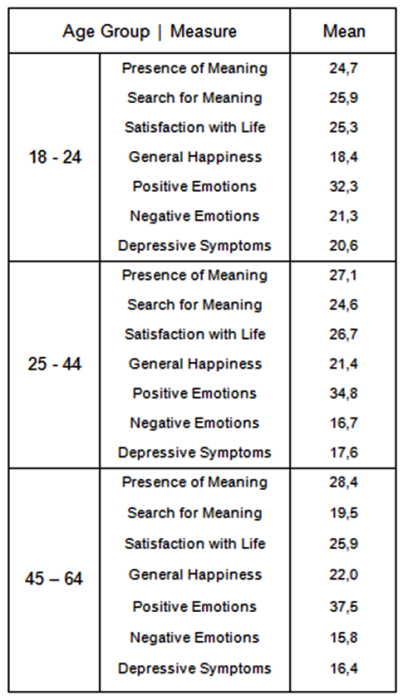
A lot of people out there are afraid of getting old. But probably they shouldn´t be. Time and time again, research shows that getting older means getting happier for most people. A couple of days ago, I posted a link to a survey that is meant to replicate an already existing study on meaning and satisfaction with life across different age groups. 100 people participated in less than three days. Thank you very much for help your help!
Now here are some of the results:

The table shows the means for different measures of our study. As you can see, the oldest group shows higher values in practically all of the positive measures (such as ‘General Happiness’ or the presence of ‘Positive Emotions’ – and lower values for negative measures (such as the presence of ‘Negative Emotions’ or ‘Depressive Symptoms’).

Meaning and Life Satisfaction

Wrinkles should merely indicate where the smiles have been.

(Mark Twain)

History in the making: Epic Harvard Study on what keeps Men healthy and happy

Triumphs of ExperienceIn 1938 Harvard University began following 268 male undergraduate students and kicked off the longest-running longitudinal studies of human development in history. The study’s goal was to determine as best as possible what factors contribute most strongly to human flourishing. For the 30 years, George Vaillant, who also teaches in MAPP, has taken care of this study. A little while ago, he published a fascinating book on this: Triumphs of Experience: The Men of the Harvard Grant Study. It´s a fascinating into the principles of positive psychology.

If you don´t have time to read the whole book, you might want to read this article on Feelguide instead.

On Meaning and Life Satisfaction

If you are a regular reader of Mappalicious you know that I´m currently a student at University of Pennsylvania. Today, I need your help! For our statistics class, it is our duty to recreate an already existing study – so we need to gather some data.

Therefore, you could do me a really, really big favor: Please click on this link to fill out a short questionnaire. It´ll take you only about 5 – 10 minutes. This questionnaire is on meaning in life and life satisfaction.

Afterwards, you might want to read the original study. But please do this after you´ve filled in the questionnaire. Otherwise, your result may be biased.

Thank you very much in advance!

Nico

My Direction

Everybody wants more Work-Life-Balance – but should we want to want more free time?

If you look at all the surveys out there, it seems most people want to spent less time at work. Especially Millennials put a lot of emphasis on having a great work-life-balance – which, at the end of the day, means putting in less hours at the office. Sounds nice, huh? But is this really advisable? From the Positive Psychology point of view, I´d have my doubts.

One very important concept in Positive Psychology is Flow – which is a state of being deeply immersed in an ongoing activity, forgetting about the time and surroundings, completely being at one with what we do. Experiencing flow on a regular basis is a sure sign of being on the path of mental health and personal growth. Now here´s the nub of the matter:

Mihály Csíkszentmihályi, the ‘discoverer’ of Flow, used a method called Experience Sampling when first studying this phenomenon. Basically, this means giving a beeper to people and contacting them a couple of times per day over a certain period of time. When being contacted, participants are to write down in a journal what they just did, and how they felt while doing it. What Csíkszentmihályi found: people reported being ‘in the Flow’ about four times as often while at work compared to their free time. How can that be?

Let´s look at the elements of Flow:

  • Focus: Concentration on a limited Field
  • Clarity: Explicit Goals and immediate Feedback
  • Balance: Match between Skills and Challenge
  • No Problemo: Feeling of (potential) Control
  • No Sweat: Ease and Effortlessness
  • Time Warp: Altered Perception of Being
  • Self-Forgetfulness: Merging of Action and Consciousness
  • Autotelic Quality: The Journey is the Destination

The problem with leisure time is: a lot of the things we like to do lack some of the critical elements for generating Flow. Except for being asleep, watching TV is the one activity that the average person spends most time on. Watching TV does not require any skills, yet putting one´s skills to work is crucial for experiencing Flow. What´s more, you don´t have any goals while watching TV, and you don´t get any feedback (besides from: now it´s over). Csíkszentmihályi actually found that when watching TV (even a sitcom) we´re in a state that can be likened to a minor depression. Of course there are leisure activities that can generate flow, e.g., most sports, dancing, reading, and painting – among others.

But how much time do we actually spend on these activities (percental)? The moral of the story is: We should be careful what we wish for. I don´t mean to say that work is inherently good.* There´s an ever-increasing prevalence of burnout in western societies. But that´s another story. Burnout is typically not a consequence of working too many hours. It´s a consequence of working too many hours on the wrong things. Now we shouldn´t make the same mistakes in our spare time…

Elements of Flow

* If you´re interested in what Positive Psychology has to say about ‘good work’, you might want to check out the thesis of Dan Bowling, on of my antecessors in the MAPP program.

Biophilia: If you feel Blue, touch Green!

PP_Pioneer_AwardOne of the speakers at this year´s MAPP Summit has been Charlie Scudamore. He´s Vice Principal of Geelong Grammar School (GGS) in Australia. For several years now, this school has implemented the principles of Positive Psychology in its curriculum, or, for that matter, in the way the school managed on the general level. Therefore, Martin Seligman awarded Charlie with the ‘Pioneer Award’ for the application of Positive Psychology – he is now considered as one of the founding fathers of Positive Education. If you are interested in the way that Positive Psychology is implemented at GGS please click here.

In his talk, Scudamore also touched the aspect of Biophilia. The ‘Biophilia Hypothesis’ draws on evolutionary psychology to support the idea that there is an instinctive bond between human beings and other living systems. By way of example, there´s considerable evidence that spending time in the woods, or just adding plants to a room, can have a mood-boosting effect and alleviate depressive symptoms. That´s why spending time outside, especially in the ‘wilderness’, plays an important part at GGS. Charlie´s summary of this issue: “If you feel blue, touch green!”

Blue_Green