I’m still so much “in love” with Lift, a leadership book by Ryan & Robert Quinn that I’ve already written about a couple of days ago. It’s just brilliant. Actually, I want to take a marker and then just underline the whole book – but I guess that would be kind of stupid. So, for today, I’d just like to share with you passage on being other-focused:
“[M]ost people find that when they become other-focused they do not lose themselves; instead, they become their best selves. They like who they become when they care about others. This makes sense when we realize that our identities are inseparable from our relationships with others. We are social creatures, biologically wired to empathize with each other. Becoming other-focused does not eliminate our unique characteristics, it draws on our unique characteristics to help us make more or our relationships.”
Most managers behave as if they were still in high school. The primary goal is not being laughed at.
This sentence resonates with/in me ever since I’ve heard it three days ago. Professor Robert Quinn, co-founder of the Center for Positive Organizations at the Ross School of Business (Michigan) coined it during a workshop on building positive cultures which was part of the Positive Business Conference 2016.
This is, of course, not the first time someone explained to me that most organizations create an atmosphere of (more or less) constant fear. But I have learned over the years that, in order to really grasp a “thing”, somebody has to present it to you at the right time in just the right words.
I was so impressed after the workshop that I instantly bought his book Lift: The Fundamental State of Leadership (co-authored with his son Ryan) at the book table and devoured it on the plane back home from Detroit to Frankfurt, Germany. And what can I say? It´s one of the best books on leadership I´ve ever read.
Truth be told: I read a lot of management and psychology books (broadly speaking) and most authors on interpersonal leadership leave me rather unimpressed. I´m a senior human resources manager working in the headquarter of a multinational organization of 120,000 people, leading a team across two continents, additionally being responsible for groups of people that are part of our international trainee programs, and coordinating the efforts of multiple agencies that support us in recruiting and employer branding.
Against this backdrop, I can honestly say: Leadership is not easy. It doesn´t come down to checklists and simple recipes. Instead, it can be immensely taxing and challenging: It´s hard work. That´s why I enjoy leadership books that acknowledge and appreciate this basic condition.
Robert Quinn´s “Lift” is such a book. It draws on a useful metaphor from aerodynamics (the dynamic that makes objects fly even though they are heavier than air) but more importantly, is grounded in decades of top-tier research. The framework that serves as the outline of the book is based on an influential article in the journal Management Science from 1983, A Spatial Model of Effectiveness Criteria: Towards a Competing Values Approach to Organizational Analysis that aims at describing the basic dimensions of organizational effectiveness.
Quinn takes this framework and uses it to outline four corresponding psychological states of leadership: Purpose-centered, internally directed, other-focused, and externally open. This is the crucial point that differentiates “Lift” from most other leaderships books: It doesn´t tell (aspiring) leaders what to do on a concrete level. Instead, it serves to cultivate a certain mindset, a stance, a leadership conduct – what the author terms the fundamental state of leadership.
The author proposes we can enter this special mindset when we (implicitly or explicitly) apply a set of questions to given leadership situations, especially those that bear potential for resistance and conflict. These questions correspond to the four quadrants of the effectiveness/psychological states model.
What results do I want to create? (objective: becoming less comfort-centered and more purpose-centered).
What would my story be if I were living the values I expect of others? (objective: becoming less externally directed and more internally directed).
How do others feel about this situation? (objective: becoming less self-focused and more other-focused).
What are three or more strategies I could try in learning how to accomplish my purpose? (objective: becoming less internally closed and more externally open).
If you want to hear a short summary in Quinn´s own word, here you go:
For me, an added value of the book is that it provides a very clear definition of an individual purpose. I´ve been struggling with that concept for quite a while now. I know I will have to sharpen mine in order to live up to my full potential – but most of what I´ve read so far has left me irresolute. Here´s what Quinn proposes:
When people are purposed-centered,
they envision and pursue extraordinarily results that are not constrained by previous expectations or by expectations that they receive from others;
the results they pursue are energizing because they are self-chosen, challenging, and constructive;
they provide a clear definition of the situation, focusing people´s attention.
Most management books I read – whether I enjoyed them or not – don’t nudge me to do anything differently afterwards. I put them in a shelf and hope, at best, to remember one or two good ideas.
With “Lift”, it´s a different story. I have already printed out the four questions and I will stick them to the computer screen in my office next Monday. And I will use the aforementioned definition to further mold my individual purpose.
Share and enjoy!
P.S.
To learn more, you might want to watch Quinn´s 2013 TEDX talk.
I’m absolutely thrilled to be at the University of Michigan, attending this year’s Positive Business Conference at Ross School of Business.This post is my personal summary of the conference’s first day, brought to you via some of the tweets I’ve put out there…
Prof. Vic Strecher shared some really intriguing upsides of having a strong purpose in life. More importantly, you should check out his fabulous app JOOL.
Prof. Jane Dutton had me change my mind on using the term rockstar only in contexts that involve electric guitars. She shared with us her Flourishing Triangle framework of organizational effectiveness.
— Hanna-Kaisa Lindfors (@hannaklindfors) May 12, 2016
I was equally thrilled to be able to learn directly from Prof. Alex Edmans, whose work on the financial impact of treating employees exceptionally well has been covered extensively on Mappalicious.
Prof. Joe Arvai shared some incredible research on how to help consumers make more ethical buying decisions. E.g., why is that we can consciously choose from what part of the world our coffee comes from (and how it was cultivated) – but not with regard to our gasoline? And what if we could
After lunch, I was thrilled to have the opportunity of attending a workshop led by Prof. Robert Quinn whose blog posts I share frequently via my Positive Psychology News Digests.
Once more it became clear to me that we do not really understand “a thing” (even if we’ve heard about it a lot of times) until somebody explains it to us in the exactly right words at the right time.
Of course, there were more sessions, and more speakers, and an abundance of inspiring conversations while having delicious food – but I cannot cover it all here.
Robert is professor at the University of Michigan and serves on the faculty of Organization and Management at the Ross Business School. He is one of the co-founders and of the Center for Positive Organizations and author several bestsellers on management.
Description of the book (taken from the book´s wrapper):
The problem is that leaders are following a negative and constraining “mental map” that insists organizations must be rigid, top-down hierarchies and that the people in them are driven mainly by self-interest and fear. But leaders can adopt a different mental map, one where organizations are networks of fluid, evolving relationships and where people are motivated by a desire to grow, learn, and serve a larger goal. Using dozens of memorable stories, Quinn describes specific actions leaders can take to facilitate the emergence of this organizational culture—helping people gain a sense of purpose, engage in authentic conversations, see new possibilities, and sacrifice for the common good.
The book includes the Positive Organization Generator, a tool that provides 100 real-life practices from positive organizations and helps you reinvent them to fit your specific needs. With the POG you can identify and implement the practices that will have the greatest impact on your organization.
For me, the most intriguing part of the book is Quinn´s proposition to see organizations not as more or less static entities, but rather as a systems of tensions. This figure provides a nice overview:
The remainder of the book is equally valuable. If you´re looking for management book that is based on solid science (Positive Organizational Scholarship) and yet offers jargon-free language and actionable ideas, “The Positive Organization” is for you.




 I was so impressed after the workshop that I instantly bought his book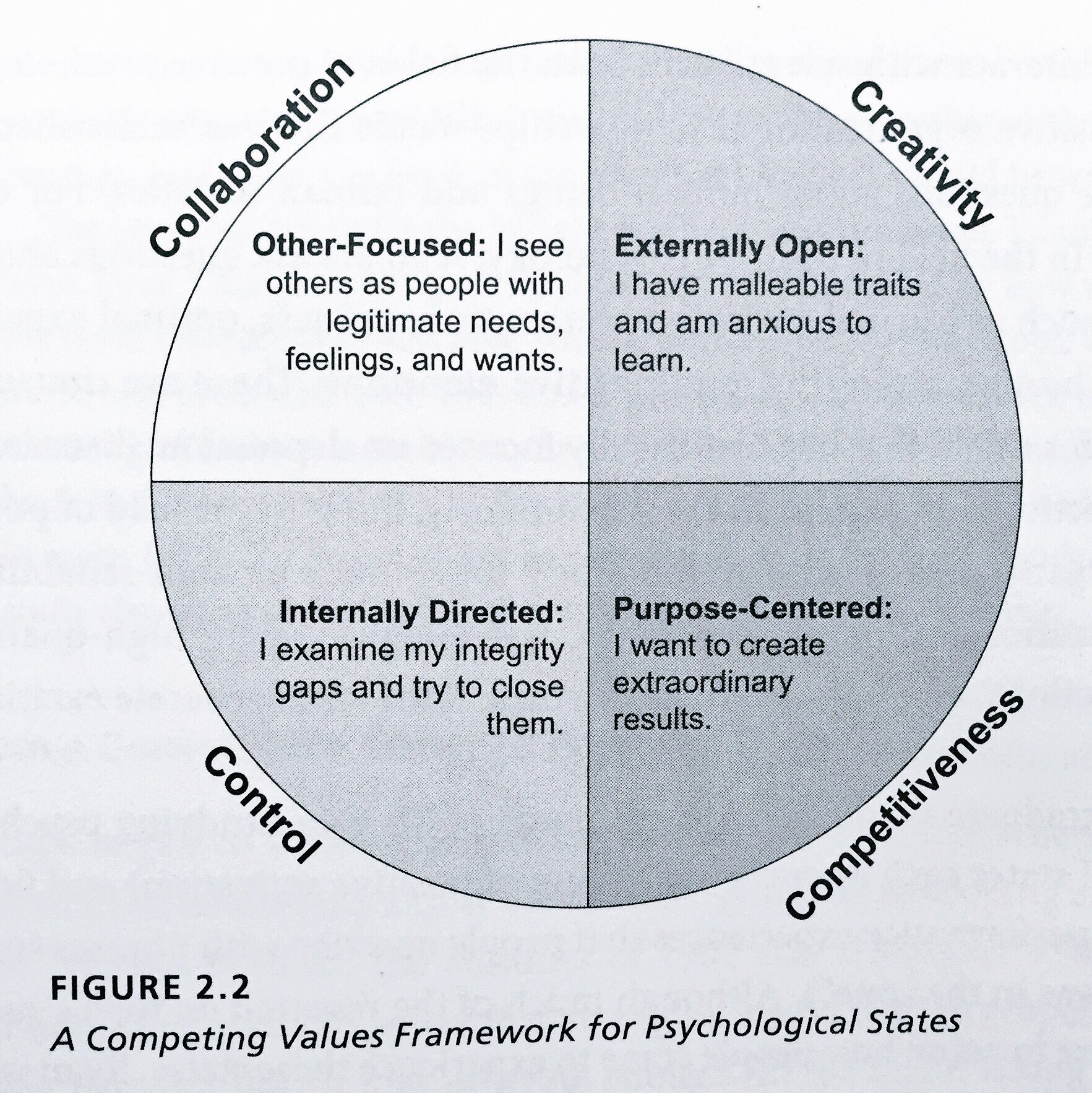


 I know I probably should be talking about Adam Grant´s
 Mappalicious