I sometimes struggle with the difference of the terms “meaning” and “purpose” – especially, as the German language doesn’t really provide distinct translations. The definition of Picasso really helped me to get a grasp on the distinction.
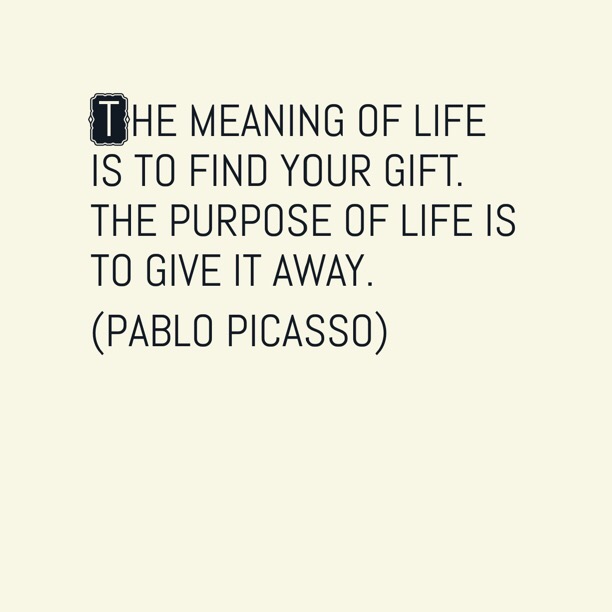
I sometimes struggle with the difference of the terms “meaning” and “purpose” – especially, as the German language doesn’t really provide distinct translations. The definition of Picasso really helped me to get a grasp on the distinction.
Are you eager to get some fresh perspectives on Positive Psychology? Here you go…
Michelle Gielan: Broadcasting Happiness: The Science of Igniting and Sustaining Positive Change. Michelle is a former CBS News anchor and is a Penn MAPP alum. About the book:
“In Broadcasting Happiness, Gielan shows us how our words can move people from fearbased mindsets, where they see obstacles as insurmountable, to positive mindsets, where they see that change is possible and take action. Using scientifically proven communication strategies, we have the ability to increase others’ happiness and success at work, as well as our own, instantly making us more effective leaders.”
Shannon Polly & Kathryn Britton (Eds.): Character Strengths Matter: How to Live a Full Life. Shannon and Kathryn are also Penn MAPP graduates working at the intersection of research and consulting. About the book:
The book brings Peterson´s and Seligman´s character strengths “to life with stories involving children, teenagers, adults, and elders and occurring in family life and business settings, in the present and in the distant past, in locations from China to the United States to the Middle East. Research shows that using character strengths in new ways for a week makes people happier up to six months later. This book includes many ideas for using your character strengths in new ways.”
J. Harold Ellens, Theo D. McCall & David Bryce Yaden (Eds.): Being Called: Scientific, Secular, and Sacred Perspectives. David was an assistant instructor in during my stay in the Penn MAPP program and has his own Mappsterview. About the book:
“This unique book is an essential resource for interdisciplinary research and scholarship on the phenomenon of feeling called to a life path or vocation at the interface of science and religion.”
Emma Seppälä: The Happiness Track: How to Apply the Science of Happiness to Accelerate Your Success. Emma is the Science Director of Stanford’s Center for Compassion and Altruism Research and Education and founder of Fulfillment Daily. About the book:
“Drawing on the latest findings from the fields of cognitive psychology and neuroscience—research on happiness, resilience, willpower, compassion, positive stress, creativity, mindfulness—Seppälä shows that finding happiness and fulfillment may, in fact, be the most productive thing we can do to thrive professionally.”
Angela Duckworth: Grit: The Power of Passion and Perseverance. If you are remotely interested in Positive Psychology, it is not necessary to introduce Angela, but for the sake of consistency in this article, she´s a professor at Penn´s Positive Psychology Center and a close colleague of Martin Seligman. About the book:
“Why do some people succeed and others fail? Sharing new insights from her landmark research on grit, MacArthur “genius” Angela Duckworth explains why talent is hardly a guarantor of success. Rather, other factors can be even more crucial such as identifying our passions and following through on our commitments.”

 Originally coined by German philosopher Nietzsche, the following quote has become a piece of common knowledge: “That which does not kill us makes us stronger”. Most people have – at one point or another – made the experience that going through really tough times may render us stronger than before, and not shattered as one would initially expect. In psychology, this mechanism is labeled Post-Traumatic Growth (PTG; here´s an overview of the idea).
Some people might even claim that there is no gain without pain. Turns out, that this view may be wrong, or at least incomplete. In a 2013 article published in the Journal of Positive Psychology titled Gains without pains? Growth after positive events, Ann Marie Roepke, Ph.D. student at Penn´s Positive Psychology Center, presents evidence for what she calls Post-Ecstatic Growth, based on a survey among some 600 people. Basically, Roepke had people name the one experience in peoples lives that they remember as the most positive (e.g., the birth of a child). Then, she asked people to specify which category best characterized their positive event, based on Seligman´s PERMA framework and which positive emotions had been evoked by the event (e.g., in awe, inspired, uplifted, joyful, content, fascinated etc.). Additionally, she assessed the outcome of that event, for instance, feelings of personal growth or “doors opening up” for new possibilities in life.
In short, Roepke found clear evidence for the existence of Post-Ecstatic Growth. Here are some excerpts from the discussion section of her article:
Positive events can, in fact, catalyze growth. Although hedonic happiness levels tend to return to baseline after positive events, important changes in eudaimonic well-being and in worldview may remain. Four domains of growth are particularly important after positive events:
Some positive experiences are more likely to lead to (self-perceived) growth than others. […] Events that evoke stronger positive emotions are more closely linked to growth. This is consistent with Fredrickson’s broaden-and-build theory: positive events can provide opportunities to expand one’s thought-action repertoire, and this expansion can be perceived as growth. Indeed, participants who reported that a positive experience opened their eyes to new opportunities, goals, roles, and values also felt they had grown more. […] Inspiration, awe, and elevation are especially important positive emotions for growth. […] In contrast, more hedonic positive emotion (e.g. feeling joyful and content) predicts less growth.
Inspiration is related to meaning, a sense of connection to something greater than the self. Meaning, like inspiration, is closely tied to growth: meaningful experiences are associated with more growth than experiences of accomplishment, engagement, relationship, and hedonic positive emotion.
Roepke´s conclusion:
Our best moments can inspire us, connect us to something greater than ourselves, and open our eyes to new possibilities, ultimately giving rise to growth.
Hence, there is gain without pain. If we seek out the right positive experiences, we are able to experience gain from previous gains, possibly entering into an upward-spiral of growth.
Feeling that your work has a deeper meaning or purpose has many positive consequences, for yourself as well as your organization: For instance, higher levels of engagement, job satisfaction, and (individual) performance. Therefore, researchers as well as practitioners have tried to find the antecedents of meaning in work for quite some time. Yet, it turns out that it´s a pretty complicated issue. A job that yields a lot of meaning for one person might feel totally meaningless for another individual.
Where should we look for the source of meaning in work? Is it something that can be found within ourselves? Does it depend on the type of job? Or is it determined by some characteristics of the organization? The answer is: very likely, all of those factors do play their role – and in part, meaning depends on the interaction between the characteristics of the person and those of the job.
In an empirical study published in the Journal of Positive Psychology, Tatjana Schnell and her colleagues surveyed some 200 people from different occupational backgrounds. In short, here´s what they´ve found:
When looking at all factors in a single model…
All in all, those attributes are able to predict almost 50% of the variance pertaining to participants´ level of perceived in meaning in work (that´s quite a lot in the context of psychological research). To put in everyday language:
We find meaning in our work when we frequently have the opportunity to perceive the (positive) outcome of our individual contribution, when our organization promotes a culture of fairness, trust, support – and authentically commits to some “greater good”, and when we feel that our job provides us with lots of opportunities to use our unique talents and matches our personal values.
In another fascinating article, Brent D. Rosso et al. try to provide an integrative model that compasses (more or less) all known factors that influence perceived meaning in work. Personally, I think it´s a very insightful (and: beautiful…) piece of research – and I will reread it frequently. I think, it is pretty self-explanatory, so I´ll leave it up to you to make the most of it.

 One of the central tenets in Positive Psychology goes as follows: Other People Matter. It was coined by the late Christopher Peterson as the shortest possible summary of research on human wellbeing. Peterson wanted to make the point that having healthy relationships with family, friends, and coworkers turns out to be the strongest predictor of happiness (and oftentimes: health) in most studies on human wellbeing.
A recent study by Nathaniel Lambert et. al titled To Belong is to Matter: Sense of Belonging Enhances Meaning in Life sheds additional light on this relationship. Here´s a shortened version of the article´s abstract:
We found correlational, longitudinal, and experimental evidence that a sense of belonging predicts how meaningful life is perceived to be. Additionally, we found a strong positive correlation between sense of belonging and meaningfulness. Furthermore, we found that initial levels of sense of belonging predicted perceived meaningfulness of life, obtained 3 weeks later. Furthermore, initial sense of belonging predicted independent evaluations of participants essays on meaning in life.
In short, what they are saying is:
Belonging = Meaning
Or, more precisely: If I matter to other people, my life matters.
I´ve already posted a list of 20+1 Positive Psychology TED talks a while ago. Here´s some more for you…
 I have to admit: I weep easily. But then, I mostly cry for joy. Very frequently, my heart just overflows with love or gratitude – and my eyes seem to be the only outlet.
Today is a bank holiday in Germany, so unlike most workdays, I sat down to have an unhurried breakfast with my wife and the Little Guru. Towards the end, they played my wife´s favorite song on the radio, so she got up, went from the dining room into the living room and started to dance playfully. Of course, the Little Guru wanted to join in.
Ten seconds later, they were holding hands and jumping around in circles, laughing and shouting boisterously. All of that time, the bright morning sun entered the room through our large garden windows, lighting up their faces, giving them an almost angelic complexion.
I watched them for a minute or so – and that´s when I cried again. I am lucky.
Happy Father´s Day to all of you!
A friend advised me to read The Gifts of Imperfection by Brene Brown – and I do right now. I’d like to share this quote with you that, in my mind alludes, among other things, to the concept of character strengths in Positive Psychology.

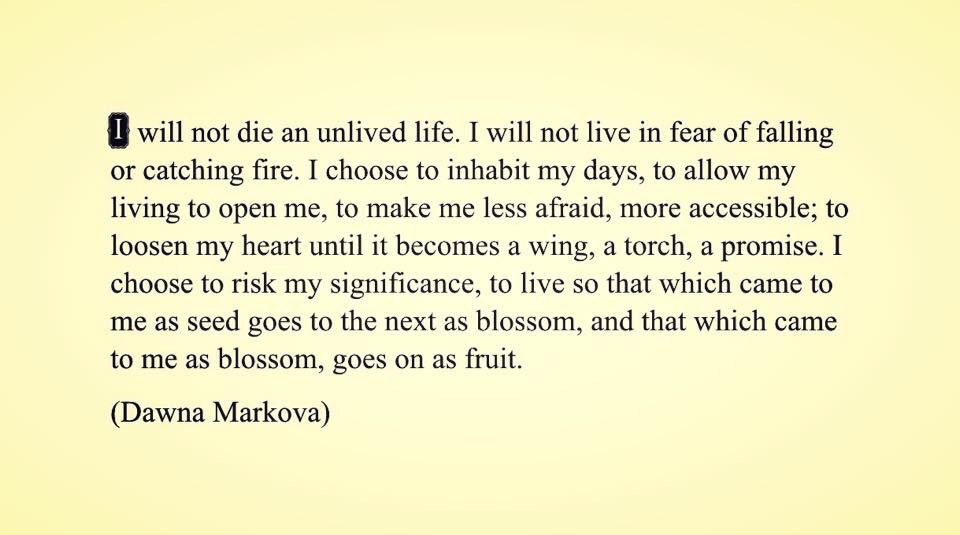
Yesterday, I stumbled upon this beautiful poem which teaches us about the power of purpose. Frankly speaking, I hadn’t heard of the author before. But there is a book by the same name (I will not die an unlived life) which I’ve just ordered – so maybe, there’s more to come here…
Michael Steger is one of the world’s foremost experts on the subject of meaning in life. Its antecedents, its consequences, and how to find it. In this 30-minute talk, he shares his (scientific) wisdom. Share and enjoy!
 Mappalicious