March 20th is UN´s International Happiness Day: Learn about Positive Psychology from 18 MAPP Alumni – Free Online Conference

Tomorrow is the United Nations´ official International Day of Happiness.

Speaking at the High Level  Meeting on “Happiness and Well-Being: Defining a New Economic  Paradigm” convened during the sixty-sixth  session of the General Assembly the  Secretary General Ban Ki-moon  said:

The world needs a new economic  paradigm that recognizes  the parity between the three pillars of sustainable  development.  Social, economic and environmental well-being are indivisible.  Together they define gross global happiness.

To support the UN on this mission, 18 MAPP Alumni are hosting a free online conference to share their knowledge on Positive Psychology, Well-Being, and Happiness. It´s going to be a wide array of PP topics brought to you by a fascinating group of people.* Among them is Emilia Lahti which you might knwo from the very first Mappsterview.

MAPP Conference - International Happiness Day

If you´d like to have more information and join the conference, please klick here.


* Yes, I do sense a slight gender imbalance here. Being a male Mappster, I´m working on that…

On Friendship, Love, and the Benefits of Aging

Aging WellFor whatever reason, I am confronted with the issues of aging (and death…) a lot over the recent weeks. My mom had to go to the hospital, and in my circle of friends, parents got sick as well – or even died. And while that is distressing and painful emotionally, I know rationally that getting old(er) is nothing to be afraid of. Because getting older (for most of us) means getting happier. We get less anxious, more satisfied, and get to a deeper understanding of the meaning of (our) life.

While being on the plane that brought me to Philly for the MAPP onsite, I watched the movie Last Vegas starring Robert De Niro, Michael Douglas, Morgan Freeman, and Kevin Kline. It´s a fun-loving, pleasantly over-the-top “geriatric” version of Hangover. Most of all, it´s a story of aging well – and the power of (life-long) friendship.

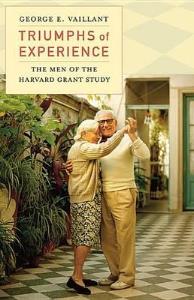
Triumphs of ExperienceCoincidently, one of the guest lecturers of this month´s MAPP onsite has been (some 80 years old) George Vaillant, who´s been the director of the world-famous (Harvard) Grant Study – which for 75 years followed the lives of 268 physically and mentally healthy Harvard college sophomores from the classes of 1939-1944, and a second cohort of 456 disadvantaged non-delinquent inner-city youths who grew up in Boston neighborhoods between 1940 and 1945. Vaillant writes about the results of this study in his books Aging Well (2003) and Triumphs of Experience (2012). There´s lots of interviews available with Vaillant – here, I´ll point you to one for the Huffington Post. Two main points that came out of the study:

Love is really all that matters.

Connection is crucial.

There you have it. The Beatles were right: All you need is love. My parents will both turn 70 next year. And by March 2014, they will be married for 46 years. I hope that my wife and I one day will achieve the same…

If you´d like to have more input, please watch this TED talk on the benefits of aging by Laura Carstensen who is Director of Stanford´s Center on Longevity.

Hell is other People? On being Happy with & without Others

The MAPP program is a fulltime program – but combines onsite classes with long-distance learning periods. Part of the distance learning comprises a lot of reading (Who would have thought of that…) and writing essays about a wide array of positive psychology topics. I´ve decided to post some of those essays here on Mappalicious. Surely, they´re not the be-all and end-all of academic writing. But then again, it would also be a pity to bury them in the depths of my laptop…

Affection

There is an abundance of proverbs that are suggestive of the positive upshots of close relationships. By way of example, we say “no man is an island” and therefore “a sorrow shared is a sorrow halved”. Or vice versa: “A joy shared is a joy doubled.”

Positive psychology and adjacent disciplines underscore this importance of close relationships, be it friendship, love, or the support of a larger social entity (Reis & Gable, 2003). When asked to give a short definition of positive psychology, the late Christopher Peterson used to say: “Other people matter.” (2006, p. 249). Fredrickson (2013) complements this observation by stating that love (and its benefits) cannot be a matter of one person, but resides in pairs or groups of people. For Seligman (2011), close relationships are of uttermost importance as well. They are embodied by the letter R in the acronym PERMA which represents his framework of human flourishing.

There is ample evidence that experiencing a sense of relatedness is a fundamental need of humans (Baumeister & Leary, 1995) – and other mammals (Harlow, 1958). Accordingly, feeling close to others has several positive consequences. For instance, married couples on average are happier than singles or divorced women and men, and they also tend to live longer (Peterson, 2006; Fredrickson, 2013). Similar results have been found for long-lasting friendships (Myers, 2000; Demır & Weitekamp, 2007). Conversely, feeling lonely over longer periods of time has shown to be detrimental to our mood and, subsequently, health (de Jong Gierveld, 1998; Hawkley & Cacioppo, 2010). In addition, researchers have shown that happiness tends to spread in social networks. Being surrounded by happy people results in an increased likelihood of being happy oneself (Fowler & Christakis, 2008; Christakis & Fowler, 2009).

Yet, there is another perspective on close relationships. The existentialist philosopher Jean-Paul Sartre coined the famous quote “Hell is other people” (1944, p. 191) and he may have had a point in saying so. After all, relationships are the source of some of our greatest joys, but also the context for some of our greatest sorrows. Couples regularly hurt each other (Feeney, 2004) and being physically abused is much more likely in the context of one´s family than with total strangers (Emery & Laumann-Billings, 1998). Even the aforementioned concept of social contagion can work against us. While there is statistical evidence that happiness can be transferred from one person to another, the same holds true for unhappiness and even depression (Rosenquist, Fowler, & Christakis, 2010). So what is the solution here? Are other people heaven – or are they hell after all?

The truth is: even Sartre did not believe that being around other people is necessarily bad for us. He seemed to be rather unhappy when being narrowed down to this infamous quote. Some 20 years later he said:

“Hell is other people” has always been misunderstood. People thought that what I meant by it is that our relations with others are always rotten or illicit. But I mean something entirely different. I mean that if our relations with others are twisted or corrupted, then others have to be hell. Fundamentally, others are what is important in us for our understanding of ourselves. (Sartre, 1965; cited in Contat & Rybalka, 1974, p. 99)

Obviously, Sartre emphasizes the quality of our relationships when contemplating the outcomes of being with other people. Having close relationships can have all the above mentioned upshots – but as humans we also have the potential to spoil these positive consequences if we are not careful enough.

In this spirit, I will now try to make a point that at present I cannot really substantiate with scientific research – but which may hold some truth nonetheless. I believe that in order to be happy in a relationship (be it friendship, marriage, or being part of a larger community), one has to be happy with oneself already – at least to a certain extent. This may be a case of “mesearch”, but then again, it may also be true. It is not at all unlikely that there is a kind of threshold, a minimum level of self-liking or -love that is a precondition for entering into fulfilling relationships with other human beings. To make this point, let´s reconsider the research on married couples. While it is fairly unequivocal that married people are at least a little bit happier than non-married people on average, it is not at all clear if this is due to a causal relationship. Consequently, we do not know for sure that marrying produces happiness. It might just as well be true that people who are already happy before getting married stand a better chance of finding and keeping a life partner (Peterson, 2006). Looking at my own life, I find this to be true. Now that I am married man and have child, I am definitely happier than I was before having met my wife. But: I definitely needed to “come to terms with myself” first in order to be prepared to let myself in for this relationship. Once again: I could not find any convincing empirical evidence for this idea – but I am fairly sure that many people would agree based on their own experiences.

To conclude, I propose that well-being neither resides in the individual alone, nor that it is solely confined to instances where we are with other people. Happiness and well-being are certainly multiplied when shared with others – but we have to “bring something to the table” in the first place in order to make it work.

References

  • Baumeister, R. F., & Leary, M. R. (1995). The need to belong: desire for interpersonal attachments as a fundamental human motivation. Psychological Bulletin, 117(3), 497-529.
  • Christakis, N. A., & Fowler, J. H. (2009). Connected: The surprising power of our social networks and how they shape our lives. New York: Little Brown and Company.
    Contat, M., & Rybalka, M. A. (1974). The writings of Jean-Paul Sartre (Vol.1). Evanston: Northwestern University Press.
  • de Jong Gierveld, J. (1998). A review of loneliness: Concept and definitions, determinants and consequences. Reviews in Clinical Gerontology, 8, 73-80.
  • Demır, M., & Weitekamp, L. A. (2007). I am so happy ’cause today I found my friend: Friendship and personality as predictors of happiness. Journal of Happiness Studies, 8(2), 181-211.
  • Emery, R. E., & Laumann-Billings, L. (1998). An overview of the nature, causes, and consequences of abusive family relationships: Toward differentiating maltreatment and violence. American Psychologist, 53(2), 121-135.
  • Feeney, J. A. (2004). Hurt feelings in couple relationships: Towards integrative models of the negative effects of hurtful events. Journal of Social and Personal Relationships, 21(4), 487-508.
  • Fowler, J. H., & Christakis, N. A. (2008). Dynamic spread of happiness in a large social network: Longitudinal analysis over 20 years in the Framingham Heart Study. British Medical Journal, 337, a2338.
  • Fredrickson, B. L. (2013). Love 2.0: How our supreme emotion affects everything we feel, think, do, and become. New York: Hudson Street Press.
  • Harlow, H. F. (1958). The nature of love. American Psychologist, 13, 673-685.
  • Hawkley, L. C., & Cacioppo, J. T. (2010). Loneliness matters: a theoretical and empirical review of consequences and mechanisms. Annals of Behavioral Medicine, 40(2), 218-227.
  • Myers, D. G. (2000). The funds, friends, and faith of happy people. American Psychologist, 55(1), 56-67.
  • Peterson, C. (2006). A primer in positive psychology. New York: Oxford University Press.
  • Reis, H. T., & Gable, S. L. (2003). Toward a positive psychology of relationships. In C. L. Keyes & J. Haidt (Eds.), Flourishing: The positive person and the good life (pp. 129–159). Washington, DC: American Psychological Association.
  • Rosenquist, J. N., Fowler, J. H., & Christakis, N. A. (2010). Social network determinants of depression. Molecular psychiatry, 16(3), 273-281.
  • Sartre, J.-P. (1944). In camera and other plays. Harmondsworth: Penguin.
  • Seligman, M. E. (2011). Flourish: A visionary new understanding of happiness and well-being. New York: Free Press.

There is no way to Happiness. Happiness is the way. But: to what or where?

“There is no way to happiness. Happiness is the way.” is a quote by the Buddha. I have not spoken to him in person (at least not to his 2,500 B.C. incarnation…) but what he probably meant is that happiness is not a goal that can be attained (for good). Rather, happiness is a consequence (or rather: byproduct) of doing certain things – and refraining from doing certain other things. This view opposes modern materialistic notions of life where we are repeatedly told something along the lines of “If you achieve X/if you manage to get Y – then you´ll be happy.”

Buddha´s quote is in line with other great thinkers of his time: Aristotle thought that eudaimonia (the “good life”, flourishing) was a byproduct of leading a virtuous life, where a virtue can be found right in the middle between two vices (e.g., courage lies between cowardice and imprudence). Confucius equally propagated leading a life guided by certain virtues. For instance, he formulated an early version of the Golden Rule that was made famous in the West by my compatriot Immanuel Kant.

The Science of Positive Psychology takes these sages at their word – and has gathered some empirical evidence on the issues. By way of example, happiness is a consequence of…

But if happiness is a way instead of a destination – I assume it´s also reasonable to ask: the way to what or where?

Man and Dog at Dawn

Typically, we ask ourselves what we have to do in order to be happy. But what if happiness is not the goal?

What if happiness were the input variable – not the outcome?

By now, we do know a lot about this way of looking at psychological well-being. For instance, happiness leads to …

In order to start being happy right now, I suggest you (re-)visit this video

Heavy. Metal. Heart. Finding Happiness in Angry Music…

The second and final semester of the 2013/14 MAPP program is under way. The first onsite period is history already. While the first semester has (more or less) focused on the theoretical underpinnings of positive psychology, the second semester focuses on the practical application of that knowledge in different contexts. One of this semester´s course is reserved exclusively for the connection between positive psychology and the humanities. We will systematically explore how “the good life” can be found in art, poetry/novels, and music (among other things).

Therefore, last Friday, the whole course went to see a concert of the Philadelphia Orchestra, an evening that focused on Russian composers, especially Tchaikovsky´s 4th Symphony. While I enjoyed this evening tremendously, it is unlikely that I will go to another classical concert in the near future – because for more than 20 years now, my heart has been captured by a different kind of music: Heavy Metal!

Mano Cornuta

By Heini Hansen (GFDL or CC-BY-SA-3.0) via Wikimedia Commons.

It started out around age 12 with “soft” stuff like German superheroes The Scorpions, moving over to (the at that time inevitable) Guns n’ Roses, than progressively getting heavier with classics such as Iron Maiden or Savatage, and German Speed Metal à la Helloween, Gamma Ray, and Blind Guardian. Later I moved on to neo-classical sounds such as Stratovarius, guitar heroes like Yngwie Malmsteen, and Symphonic Metal as played by Rhapsody (of Fire).

During my adolescent years, I´ve also had a long-term affair with some Dark/Gothic Metal bands such as Amorphis and Tiamat – but I never really embraced those growling or screaming vocals. As a consequence, I stayed clear of really heavy Thrash and Black Metal. Around 23, I got rid of most of the typical clothing – but the love for the sound of heavily distorted guitars and a solid double bass drum remained – and probably will do so until the end of this life.

Now where´s the connection to (positive) psychology here? The thing is: there´s not too much official (psychological) research on heavy metal. And the few studies that do exist typically deal with (supposed) negative consequences of listening to heavy music, such as aggression, suicidal risk, and drug abuse. At the same time, there´s no doubt about the fact that most people use music to control (dampen or amplify) and even create certain moods and emotions.

Heavy Metal concerts are distinctly peaceful and non-violent places – if you manage to avoid the mosh pit, that is…

I´m really trying not to be lopsided here – but to me there always seemed to be something wrong about these studies. Heavy Metal is – for the most part – aggressive music, agreed. But this does not automatically imply Heavy Metal fans are aggressive people. I´ve been to hundreds of concerts in my lifetime. From these experiences, I can say that Heavy Metal concerts are distinctly peaceful and non-violent places – if you manage to avoid those inevitable mosh pits, that is. 🙂

Most of us are truly amicable and fun-loving guys (and girls of course). It just so happens that some of us are also a little burly – and not to fond of shaving or going the hairdresser.

I did not choose it. It chose me. Listening to the arpeggios in the first solo of Yngwie Malmsteen´s Mad Dog elicits feelings in me that otherwise can only be aroused by sex and really really good dark chocolate.

Quite obviously, different people have different “internal energy levels” and therefore react to “different vibrations” when exposed to music (please excuse the esoteric language…). What I mean is: my favorite TV series of all times is Ally McBeal. I love shopping and romantic comedies starring Hugh Grant. And I happen to LOVE Heavy Metal. I did not choose it. It chose me. Listening to the arpeggios in the first solo of Yngwie Malmsteen´s Mad Dog (starts approx. at 1:42) elicits feelings in me that otherwise can only be aroused by having sex or eating really really good dark chocolate.

My esoteric hunch is echoed in one of those rarer studies that finds headbangers are just regular people that happen to feel good while listening to high-intensity music. It´s not a coincidence that a lot of metalheads are also very fond of Wagner. The study concludes by stating that the

“most widely accepted conclusion is that heavy metal fans are in general angrier, more agitated, and more aroused than fans of other musical styles. The results of this study do not support this speculation. No pretest differences were found among subjects’ levels of state arousal, state anger, or trait anger.”

In addition, the researchers find what is called an interaction affect. To cut a long story short: there actually are people who become angry when listening to Heavy Metal. Precisely, people who do not like Heavy Metal. Surpriiiise! Happens to me when I have to listen to Miley Cyrus. I mean, I love to watch Miley Cyrus – but only when the TV is muted. Wrecking Ball is a great piece of visual art when accompanied by Manowar´s Heavy Metal Daze.

Heavy Metal WheelchairI was inspired to write this post (and stole the second part of the title…) by a piece on The Atlantic magazine. The author elaborates on the potential uplifting effect of getting in touch with our innate animal-aggressive nature when listening to Heavy Metal: “There’s something cleansing about engaging with emotions we might not usually let ourselves feel.”

Closing remarks: While doing some research for this article, I was quite amused to find out that the Mano Cornuta (Sign of the Horns; as displayed in both pictures) is also an ancient Buddhist mudra by the name of Karana – which is used to fight off evil spirits. There you have it! We´re the good ones, really…


Source for picture of wheelchair headbanger

Getting older? Do not fear! For Age brings you Happiness…

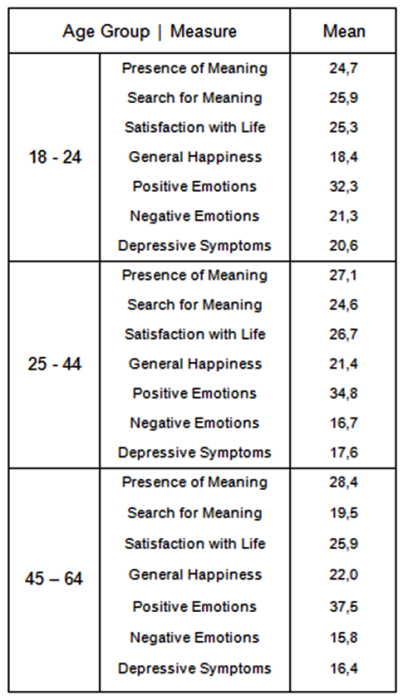
A lot of people out there are afraid of getting old. But probably they shouldn´t be. Time and time again, research shows that getting older means getting happier for most people. A couple of days ago, I posted a link to a survey that is meant to replicate an already existing study on meaning and satisfaction with life across different age groups. 100 people participated in less than three days. Thank you very much for help your help!
Now here are some of the results:

The table shows the means for different measures of our study. As you can see, the oldest group shows higher values in practically all of the positive measures (such as ‘General Happiness’ or the presence of ‘Positive Emotions’ – and lower values for negative measures (such as the presence of ‘Negative Emotions’ or ‘Depressive Symptoms’).

Meaning and Life Satisfaction

Wrinkles should merely indicate where the smiles have been.

(Mark Twain)

History in the making: Epic Harvard Study on what keeps Men healthy and happy

Triumphs of ExperienceIn 1938 Harvard University began following 268 male undergraduate students and kicked off the longest-running longitudinal studies of human development in history. The study’s goal was to determine as best as possible what factors contribute most strongly to human flourishing. For the 30 years, George Vaillant, who also teaches in MAPP, has taken care of this study. A little while ago, he published a fascinating book on this: Triumphs of Experience: The Men of the Harvard Grant Study. It´s a fascinating into the principles of positive psychology.

If you don´t have time to read the whole book, you might want to read this article on Feelguide instead.

Do more of what makes you happy!

I came home to Germany from the third MAPP onsite this morning. In the afternoon, I went for a walk with my wife and the Little Guru. This is what I found in a local shop window. Wonder, for how long it has been there…

20131028-223511.jpg

Was Socrates a happy Man? And if he lived today – would he be a Blogger?

Socrates - Louvre

By Eric Gaba (CC-BY-SA-2.0) via Wikimedia Commons

The topic for the afternoon of the last day of MAPP immersion week was the trial that eventually lead to the death sentence of Socrates, arguably one of the most important philosophers of all time. There are some hints in the Apology, Plato´s account of the trial, that allude to the idea that Socrates ‘chose’ to be sentenced to death – in the sense that he could have gotten away with a significantly milder punishment, if had chosen to display a different demeanor. Yet, he stayed true to his own self (being a philosopher, asking lots of probing questions, and thereby being the ‘pain in the ass’ of most of his fellow citizens), which provoked the judges and most his fellow Athenians (“Men of Athens, I honor and love you; but I shall obey God rather than you, and while I have life and strength I shall never cease from the practice and teaching of philosophy…”). Supposedly, there were some politically motivated reasons for his death sentence as well – but that is another story.

James Pawelski, Director of the MAPP program asked us an interesting question: was Socrates a ‘happy’ man? Obviously, it´s not possible to ask him any more – but the Apology contains some hints on that topic: when investigating the text for displays of PERMA, Martin Seligman´s definition of the elements of flourishing: Positive emotion, Engagement, Relationships, Meaning, and Achievement. While it is not clear if Socrates experienced a lot of positive affect (P), it is save to say that he displayed a high level pertaining to the remaining four elements: He obviously had something which he deeply cared about and regularly was immersed in, e.g., teaching his students (E). He also had a wife and three children, as well as his students and followers that admired and valued him (R). Socrates definitely experienced a sense of meaning in his life. He felt that it was his noble duty to be a philosopher and oftentimes spoke of his inner daimon that protected and/or guided him. And finally, we are still able to read about his deeds today – which obviously is not true for most of the other men of his time (A). Bottom line: While we cannot be sure about the ‘P’, there was definitely a lot of ‘ERMA’ in his life.

Let us rest the case here. But what about the other question? Would he be a blogger today? First, I assume, it is helpful to know how this rather strange question came into being. Unlike James, I am a psychologist and coach by training, not a philosopher. So I asked him about the psychological contract between Socrates and his fellow Athenians. While he had a lot of students that would actively seek him out, he supposedly also used his Socratic Method (basically: asking someone lots of questions until he finds the right answer by himself) on a lot people that really did not want to be bothered by him. James answered analogously, that Socrates probably would not want to be named a ‘patron of the coaching business’ – but that today, he might be a kind of (political) blogger. He would try to be the thorn in the side of the leading political class, exposing their flaws and misconceptions.

Once again, we cannot ask him anymore – but I kind of like that thought…

Why talking about the weather may make you unhappy – even on beautiful days

Today has been the second day of the MAPP´s so-called immersion week. Angela Duckworth is teaching research methods and statistics, which frankly speaking will never be my favorite subject – but that´s o.k. To learn more about the methodology of psychological research and to get an idea of how research papers are crafted, we skimmed through some articles in the classroom. I´d like to share one of those with you; it was published by Matthias Mehl and some colleagues.

Now the thing is: I am German and there is this stereotype of Germans as being rather uptight, not exactly unfriendly, but – you know – a little stiff, just not that easy to talk to. We´re the so-called “nation of poets and thinkers”, but just not very good at small-talk. Which…

…tadahhh – might explain why we´re also a rather happy nation on average!

What Matthias Mehl does as a researcher: he hooks up people with tiny recording devices that switch on automatically at certain intervals over the day. As a result, he gets these little samples of our everyday behavior, especially what we say to other people and what they say to us, respectively. Here´s what he´s found out: People that spend a lot of time in the company of other people are considerably happier on average than folks who mostly like to spend time on their own. There´s nothing new here. But: it also matters to a great extent what you talk about.

There is a considerable negative correlation between life satisfaction and small talk; and a considerable positive correlation between meaningful (“deep”) conversations and life satisfaction. Talking about shallow topics too often may be not all that beneficial to our psychological well-being. This, in turn, reminded me of that little story which is commonly attributed to Socrates – but presumably is a universal parable.

The three sieves of Socrates

Once upon a time, one of the acquaintances of Socrates came running and said: “Socrates, do you know what I just heard about one of your students?”
“Wait a minute”, Socrates stopped him, “Before you tell me, I would like to conduct the three sieves test.”
“Three sieves test?”
“Yes. Before you tell me anything, take a moment to consider carefully what you are going to say and pour your words through these sieves.”
“The first one is the sieve of truth. Are you absolutely sure that what you are about to tell me is true?”
“Well… no. Actually I heard it recently and…”
“Alright”, interrupted Socrates, “So you don’t really know if it is true or not!”
“Now, let us try the second one, it is the sieve of goodness. Are you about to tell me something good about my student?”
“Well…no. On the contrary…”
“So, you want to tell me something bad about him” roared Socrates, “even though you are not certain if it is true or not?”
The acquaintance shrugged, already feeling uncomfortable.
“You may still pass the test though” said the Socrates, “because there is a third sieve – the sieve of usefulness.”
“Is what you were to tell me about my student going to be useful?”
“No, not really…” said the man resignedly. 
Socrates continued his lesson, “Well, if what you want to tell me is neither true nor good nor useful, why tell me at all?”