
Latest Blog Posts
2013: Top 10 Book List on Positive Psychology
 Just a quick note: This link leads to a great book list issued by the Greater Good Science Center at Berkeley, one of the finest institutions in the science and business of positive psychology.* A couple of the authors also teach in the MAPP program.
*Of course, nothing can compare to the Positive Psychology Center at Penn… 😉
When feeling good feels better than good: the Benefits of Emotional Contrasting
The MAPP program is a fulltime program – but combines onsite classes with long-distance learning periods. Part of the distance learning comprises a lot of reading (Who would have thought of that…) and writing essays about a wide array of positive psychology topics. I´ve decided to post some of those essays here on Mappalicious. Surely, they´re not the be-all and end-all of academic writing. But then again, it would also be a pity to bury them in the depths of my laptop…
But what if pleasure and displeasure were so tied together that whoever wanted to have as much as possible of one must also have as much as possible of the other — that whoever wanted to learn to “jubilate up to the heavens” would also have to be prepared for “depression unto death”?” And that is how things may well be.
(Nietzsche)
 One of my most important teachers while training to become a coach regularly used a metaphor in order to convey the idea that, while there are a lot of people out there that feel good about their lives, there may be separate groups of individuals that may feel equally good, but still radiate a disparate ‘energetic signature’. Using the concept of rebirth (without necessarily believing in it), he told us that, because of their karma, some people are entitled to what could be described as a ‘recreational incarnation’. After a lot of suffering in former incarnations, they now get to live a pleasant and happy life without too much pain, loss, and other turbulences – resulting in an affable, joyful, but (potentially) also slightly shallow character. On the other hand, there are people that know the ‘Dark Night of the Soul’ from their own experience earlier in the current life. While they can be just as happy and agreeable as the aforementioned group, they tend to be somewhat graver or deeper.*
In this paper, I want to take a look at this distinction. At a less arcane level, the question could be: When two people display the same value on a measure that is supposed to quantify happiness – do they really feel the same when one person has been at that level for (more or less) her whole life, while the other has experienced longer periods of considerably unhappier emotional states?
Positive emotions play a central role in positive psychology (Fredrickson, 2001; Fredrickson, 2009). Because of the particular emphasis on positive affect especially during the early period of the field, some scholars criticized positive psychologists for excluding the negative side of human emotions from their inquiries (e.g., Tennen & Affleck, 2003). It is important to say that this is, in fact, not the case (Seligman & Pawelski, 2003; Peterson, 2006). Rather, positive psychology asserts that negative emotions do exist and are just as ‘natural’ as positive emotions. It´s just that the focus of researchers and practitioners, for the first 100 years of psychology as a science, has been firmly on the negative dimension of human experience, which now warrants a shift towards the opposite direction (Seligman & Csikszentmihalyi, 2000).
For example, one branch of research in (positive) psychology focuses on bouncing back from negative experiences (Tugade & Fredrickson, 2004), coping with unfortunate events (Folkman & Moskowitz, 2000), psychological resilience in the face of adversity (Masten, 2001), and, particularly, post-traumatic growth (Tedeschi & Calhoun, 1996; Linley & Joseph, 2004; Tedeschi & Calhoun, 2004). By way of example, there is considerable evidence that a person cannot only recover and get back to normal after a severely stressful event such as a potential life-threatening illness, but can actually attain a higher level of well-being and satisfaction, e.g., via finding a deeper meaning or a more profound sense of purpose in life (Helgeson, Reynolds, & Tomich, 2006; Lyubomirsky, 2008). So while, by and large, it seems difficult to sustainably alter a person´s general level of happiness (Lykken & Tellegen, 1996), there is reason to believe that overcoming extremely stressful events may result in such a shift.
But there may be other mechanisms that can explain how we can benefit psychologically from having gone through troubled times. Even if a person may not be happier than a fellow human being with regard to objective measurement, the aforementioned may still perceive his or her state as being more favorable than the latter person. For a thought experiment, let´s consider two people of similar age and other characteristics that both display scores around the 80th percentile on a measure that captures happiness or a similar variable of psychological well-being. The difference is: the first person has by and large been on that level for his previous life, while the other person has suffered from recurring episodes of depression – but has now recovered for good. Will being equally happy actually feel the same for both? I argue that this is not the case. Rather, I contend the second person will be happier on the subjective level (qualia). She will feel happier about being happy because she can still remember how it felt to be severely unhappy. Why should that be the case?
One of the earliest objects of investigation in psychological science has been human perception, e.g., our ability to discern contrasts (Heidelberger, 2004). While scholars mostly focused on contrasts as perceived on the sensory level (light intensity, loudness, weight etc.), some scientists early on investigated contrasts pertaining to the emotional sphere (Bacon, Rood, & Washburn, 1914). For instance, Manstead, Wagner, and MacDonald (1983) have shown that we tend to find humorous film content to be funnier when we were previously exposed to a horror movie (and vice versa). Obviously, the fear that is elicited by the horror movie makes the enjoyment of the comedy more intense.
While the aforementioned emotional contrast is perceived when the stimuli are presented in close temporal connection, it seems likely that this process also works for stimuli that are being felt at different points in time. It is perfectly possible to contrast a current emotional state to that of past events via voluntarily accessing episodic memory. When we compare feeling good in the present to feeling considerably worse in the past, the current emotional condition can subjectively be enhanced by a kind of meta-emotion (“It really feels good feeling so much better than how I felt back in the days…”).
So while it is common sense that ‘feeling good just feels good’, we should not forget about having felt worse in the past. It just might give us that little extra kick.
* Often, he also used to contrast this ‘species’ with the mythological character of Chiron, the ‘wounded healer’.
References
Bacon, M. M., Rood, E. A., & Washburn, M. F. (1914). A study of affective contrast. The American Journal of Psychology. 25(2), 290-293.
Folkman, S., & Moskowitz, J. T. (2000). Positive affect and the other side of coping. American Psychologist, 55(6), 647-654.
Fredrickson, B. L. (2001). The role of positive emotions in positive psychology: The broaden-and-build theory of positive emotions. American Psychologist, 56(3), 218-226.
Fredrickson, B. L. (2009). Positivity: Top-notch research reveals the 3 to 1 ratio that will change your life. New York: Crown Publishing.
Heidelberger, M. (2004). Nature from within: Gustav Theodor Fechner and his psychophysical worldview. Pittsburgh: University of Pittsburgh Press.
Helgeson, V. S., Reynolds, K. A., & Tomich, P. L. (2006). A meta-analytic review of benefit finding and growth. Journal of Consulting and Clinical Psychology, 74(5), 797-816.
Linley, P. A., & Joseph, S. (2004). Positive change following trauma and adversity: A review. Journal of Traumatic Stress, 17(1), 11-21.
Lykken, D., & Tellegen, A. (1996). Happiness is a stochastic phenomenon. Psychological Science, 7(3), 186-189.
Lyubomirsky, S. (2008). The how of happiness. New York: Penguin.
Manstead, A. S. R., Wagner, H. L., & MacDonald, C. J. (1983). A contrast effect in judgments of own emotional state. Motivation and Emotion, 7(3), 279-290.
Masten, A. S. (2001). Ordinary magic: Resilience processes in development. American Psychologist, 56(3), 227-238.
Peterson, C. (2006). A primer in positive psychology. New York: Oxford University Press.
Seligman, M. E., & Csikszentmihalyi, M. (2000). Positive psychology: an introduction. American Psychologist, 55(1), 5-14.
Seligman, M. E., & Pawelski, J. O. (2003). Positive psychology: FAQS. Psychological Inquiry, 14(2), 159-163.
Tedeschi, R. G., & Calhoun, L. G. (1996). The posttraumatic growth inventory: Measuring the positive legacy of trauma. Journal of Traumatic Stress, 9(3), 455-471.
Tedeschi, R. G., & Calhoun, L. G. (2004). Posttraumatic growth: Conceptual foundations and empirical evidence. Psychological Inquiry, 15(1), 1-18.
Tennen, H., & Affleck, G. (2003). While accentuating the positive, don’t eliminate the negative or Mr. In-Between. Psychological Inquiry, 14(2), 163-169.
Tugade, M. M., & Fredrickson, B. L. (2004). Resilient individuals use positive emotions to bounce back from negative emotional experiences. Journal of Personality and Social Psychology, 86(2), 320-333.
Grit and Flow as alternating Stages on the Road to Achievement?
The MAPP program is a fulltime program – but combines onsite classes with long-distance learning periods. Part of the distance learning comprises a lot of reading (Who would have thought of that…) and writing essays about a wide array of positive psychology topics. I´ve decided to post some of those essays here on Mappalicious. Surely, they´re not the be-all and end-all of academic writing. But then again, it would also be a pity to bury them in the depths of my laptop. So here we go…
Grit and Flow as alternating Stages on the Road to Achievement?
Seligman (2011) posits that engagement, for instance, by regularly entering into a state of Flow (Csikszentmihalyi & LeFevre, 1989), and seeking and realizing achievement (Wiegand & Geller, 2005) on and off the job are two constitutive elements of well-being. These concepts are represented by the letters E and A in the acronym PERMA, Seligman´s current outline of positive psychology. Csikszentmihalyi (1990) characterizes Flow as a state of optimal experience. The most important features of Flow are effortless attention, absence of time awareness, and absence of emotion. Seemingly contradictory, Duckworth, Peterson, Matthews, and Kelly (2007) posit that Grit, characterized as a passion and persistence for long-term goals and the associated exercise of self-control (Duckworth & Seligman, 2005), are key predictors of sustainable achievement. In this paper, I will argue that experiencing Flow and exerting Grit may be alternating stages on the same road to accomplishment – much in the same way that in- and exhaling are interchanging phases of the process of breathing.
At first glance, even though both concepts are perceived as pathways to achievement, Flow and Grit do have characteristics that seem to be somewhat incompatible. Grit is theorized as a stable character trait that does not require an immediate positive feedback loop. Individuals high in Grit are capable of sustaining determination and motivation over long periods despite experiences with failure and adversity (Duckworth et al., 2007). Their passion for long-term objectives is the principal factor that provides the energy required to keep on track amidst challenges and set-backs. Using one´s Grit may be gratifying in the end because it helps us to reach long-term goals – but is doesn´t necessarily have to feel good while still being “on the way”. Often, using Grit is the opposite of the characteristic of effortlessness. In fact, it can lead people to “torture” themselves for the “greater good”.
On the other hand, Flow is a state that is “easy” (Csikszentmihalyi, 1990). While it is important to have feelings of potential control and mastery in order to experience Flow, it does not feel like it is necessary to exert control – things seem to take care of themselves. In fact, most people report that feeling nothing at all is a typical characteristic of being “in the Flow”. Positive feelings only come after the task at hand is done. In addition, experiencing Flow is dependent on regular task-related feedback. It is attained most easily when a person´s skills and the challenge at hand are of equal magnitude.
I propose that the relationship of skill level and the difficulty of the task at hand may be the connection between both concepts. Flow is typically depicted as the optimal level between boredom and anxiety:
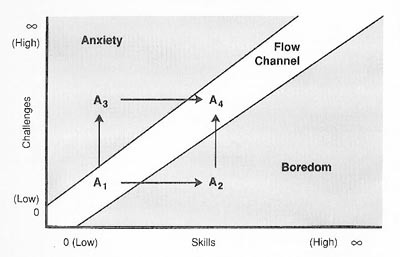
Figure 1. The Flow channel (adapted from Csikszentmihalyi, 1990, p. 70).
It seems likely that gritty persons are typically capable of overcoming the anxiety of facing challenges that seem too difficult at first. They perceive obstacles as challenges, and by conquering these challenges, the continuously expand their skill level. This, in turn, will enable them to potentially experience Flow in more difficult situations in the future. Thereby, the gratifying experience of Flow may be the reward for having pushed one´s boundaries just a little further.
To close this essay with an analogy: in my opinion, the relationship between Grit and Flow resembles the interplay of Yin and Yang in Taoism. Yin is the female, soft, or yielding principle. It can be likened to being in Flow. It´s letting go without losing control, it´s doing without doing. On the other hand, exerting Grit can be likened to Yang: it´s the male, hard, or penetrating principle. It´s holding on to preserve control, it´s doing by taking action. These principles seem to be contradictory – but in fact, they are complementary.
References
Csikszentmihalyi, M., & LeFevre, J. (1989). Optimal experience in work and leisure. Journal of Personality and Social Psychology, 56(5), 815-822.
Csikszentmihalyi, M. (1990). Flow: The psychology of optimal experience. New York: Harper-Perennial.
Duckworth, A. L., Peterson, C., Matthews, M. D., & Kelly, D. R. (2007). Grit: perseverance and passion for long-term goals. Journal of Personality and Social Psychology, 92(6), 1087-1101.
Duckworth, A. L., & Seligman, M. E. (2005). Self-discipline outdoes IQ in predicting academic performance of adolescents. Psychological Science, 16(12), 939-944.
Seligman, M. E. (2011). Flourish: A visionary new understanding of happiness and well-being. New York: Free Press.
Wiegand, D. M., & Geller, E. S. (2005). Connecting positive psychology and organizational behavior management: Achievement motivation and the power of positive reinforcement. Journal of Organizational Behavior Management, 24(1-2), 3-25.
Edit:
Just found out that I wasn´t the first person on planet Earth to have the brilliant abovementioned thoughts (What was I thinking anyway…). Here´s a very instructive blog post along similar lines by the name of Grand Unified Theory of Mastery.
On Elevation, Admiration, the Goosebumps, and Mandela
 Recently, I´ve written a post on Jonathan Haidt´s research on the emotion of awe. Closely connected to this emotion is the feeling of elevation. In fact, Haidt posits that elevation oftentimes is a result of experiencing awe. Here´s what he has to say on elevation in one of his research articles on that topic:
“Elevation is elicited by acts of charity, gratitude, fidelity, generosity, or any other strong display of virtue. It leads to distinctive physical feelings; a feeling of ‘dilation’ or opening in the chest, combined with the feeling that one has been uplifted or ‘elevated’ in some way. It gives rise to a specific motivation or action tendency: emulation, the desire ‘of doing charitable and grateful acts also.’ It is the opposite of the disgust reaction towards vice. In sum, elevation is a response to acts of moral beauty in which we feel as though we have become (for a moment) less selfish, and we want to act accordingly”.
According to Haidt, elevation can be distinguished from another ‘other-praising’ emotion: admiration. In his words:
“If elevation is a response to moral excellence that does not benefit the self, […] what is the emotional response to non-moral excellence? What do people feel when they see extraordinary displays of skill, talent, or achievement? We nominate the term admiration.”
The following 3-minute Youtube clip invokes a feeling within me that seems to be a blend of both elevation and admiration. It is an African flash mob song performed by the Soweto Gospel Choir in memory and honor of the late Nelson Mandela.* Obviously, I do not understand one word – but I googled it and supposedly it means something like “Bon Voyage” or “Godspeed”. I feel admiration just by listening to the beautiful voices – but there´s also something else. I´m deeply touched and moved to tears even though I do not know what the lyrics are about. ** But just by watching and listening, you can almost physically touch the love that those singers feel for “Madiba”.
Enjoy!
* Actually, it´s a commercial – but who cares…
** So far, this has happened just once in my life. That time, it was the song “Kawaipunahele” by Hawaiian singer Keali’i Reichel.
Win 3×2 copies of my Book “License for Satisfaction”
For my German readers (or English readers who would like to learn German…): If you would like to win 3×2 copies of my book License for Satisfaction, please visit my personal Facebook page. There, you´ll get to participate…

TEDx: The happy Secret to better Work
This is a great and immensely funny TEDx Talk bei Shawn Achor. It has got close to 6 million views on the TED homepage. Good job. I didn´t know Shawn before – until yesterday, where he retweeted my blog post on the 7 most common Misconceptions about Positive Psychology. Good job, too. 😉
I had a black Dog, his name was Depression
Event though this is blog about positive psychology, I´d really like to share with you this educational video about depression created by WHO. Unfortunately, even though so many people suffer from depression, there are even more people who don´t know about the typical symptoms and what it does to us, to our thinking, our feeling, how it interferes with leading a normal life, partnership, and so on. I think, the following video captures all that in a very palpable way. Please share and let other people know, too…
Positive Interventions: An Angel came down
 One noble duty of positive psychology is to develop positive interventions, intentional exercises that help to build positive phenomena, such as positive mood, character strength, relationships, or meaning in life. I believe that a very simple positive intervention is to listen to right kind of music. So, since Christmas is only about two weeks away, I´m going to share with you my favorite Christmas song. It´s “An Angel came down” from the first album by Trans-Siberian Orchestra, a side project of one of my favorite bands of all time, the mighty glorious Savatage.
For some reason, I can hardly listen to this song without being moved to tears – but usually, they are calm and serene tears. Enjoy…
P.S.
Winter greetings from Penn (picture)…
 Mappalicious