Organizational Energy: A Whole-System Approach

A couple of days ago, I wrote about the concept of relational energy, the idea that energy is generated via positive interactions between an organization´s members – resulting in a fully charged system.

Org_Energy_BruchToday, I´d like to introduce two other approaches that aim at assessing organizational energy. In both, St. Gallen-based (Switzerland) Prof. Heike Bruch plays a major role.

In an article Bruch co-authored with Sumantra Ghoshal in the Sloan Management Review from 2003 based on several case-studies, she introduced the idea that an organization as a whole system can be described via a grid that describes the intensity and the quality of the present energy. In doing so, she also promoted the concept of “organizational burnout”, a state that may arise when an organization spends to much time in the upper left quadrant of the energy grid. I highly recommend reading the original article – as it also provides valuable ideas on how to shift an organization from one energetic state to an another (“Slaying the Dragon” and “Winning the Princess”)

In 2011, she followed up with this article: Energy at work: A measurement validation and linkage to unit effectiveness. This further explores the idea of “whole system energy” but tackles it from a more quantified point of view. The authors define

collective energy (henceforth productive energy) as affect, cognitive arousal, and agentic behavior among unit members in their joint pursuit of organizationally salient objectives.

One important notion is that the researchers view productive energy as having affective, cognitive, and behavioral components – so it´s not only about “feeling energized”:

Affective energy refers to members’ shared experience of positive feelings and emotional arousal due to their enthusiastic assessments of work‐related issues.

Cognitive energy refers to the shared intellectual processes that propel members to think constructively and persist in search of solutions to work‐related problems, including the mental faculties to focus attention, shut out distractions, and have a desire to make “good things” happen.

Behavioral energy reflects members’ joint efforts designed to benefit the organization; it encompasses the pace, intensity, and volume with which members purposefully invest physical resources.

 The other important distinction is the facet of emergence:

We take a multilevel position on energy, conceptualizing it as both an individual‐level and a collective‐level phenomenon. We, therefore, recognize the need to discuss the nature of its emergence or how the lower‐level parent construct (i.e., individual‐level energy) materializes to form a collective construct (i.e., productive energy).

Accordingly, the authored have used a questionnaire to assess individual energy, but used that data to additionally compute a collective energy level, e.g., that of the whole business unit, by aggregating the individual energy levels. Here are some of the items they used:

  • Affective dimension: People in my work group feel enthusiastic in their job.
  • Cognitive dimension: In my work group, there is a collective desire to make something happen.

  • Behavioral dimension: People in my work group often work extremely long hours without complaining.

After statistical analyses, the authors conclude that

productive energy appears to be an emergent phenomenon. That is, energy referenced at the unit level considers the context or social environment in which individuals work and is distinct from the attributes of those individuals.

In a separate study, they also find that

the productive energy of firms is positively associated with firm performance.

I´m really eager to see how this stream of literature will develop in the future – and how it might inform practical interventions, e.g., in the field of human resources development.

Angela Duckworth and Adam Grant in the New York Times

Nico Rose - Angela Duckworth - Adam GrantTwo of my academic heroes have published pieces in the New York Times recently.
Angela Duckworth writes about cultivating, rather than discovering our passion and the corresponding career paths. The key takeaways:

Move toward what interests you

Don’t panic if you can’t think of a career path that’s a perfect fit. A good-enough fit is a more reasonable aim than a perfect one.

Seek purpose

People are hard-wired not only to gratify their personal desires but also to care for others. So ask, “In what way do I wish the world were different? What problem can I help solve?” 

Finish strong

When considering a career change…

Work as hard on your last day as on your first. No matter where you go next, you have an opportunity to make the most of where you are now.

Adam Grant writes about how the concept of authenticity might be misleading in the world of business. He proposes to strive for sincerity instead. The key takeaway:

Instead of searching for our inner selves and then making a concerted effort to express them, start with your outer self. Pay attention to how you present ourselves to others, and then strive to be the person you claim to be.

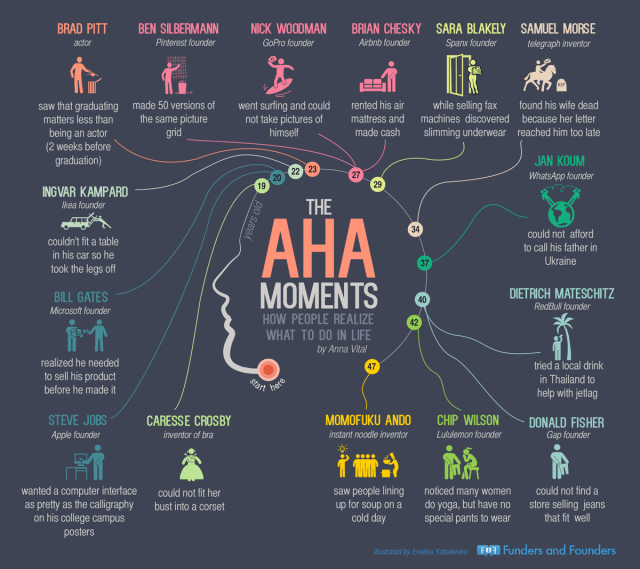
Why they did it: How successful Entrepreneurs found their Breakthrough Idea

Here´s another fantastic infographic by Anna Vital. It displays when and why exceptionally successful founders had their eureka moments, when they discovered the product or service that would ultimately become the backbone of their business model. As you will see, most of them experienced a certain lack of something, they wanted a (better) product for their own lives but couldn’t find it – and so they created it…

the-aha-moments-of-entrepreneurs-infographic

Positive Psychology News Digest on Mappalicious | No. 22/2016

My favorite pieces covering Positive Psychology and adjacent from (roughly) the last seven days.

PsyBlog: The Advantage of Being Overconfident And Self-Deluded by Jeremy Dean


Live For Live Music: Why Some People Get ‘Skin-Gasms’ While Listening To Music by Kendall Deflin


Seth Godin´s Blog: The possibility of optimism (the optimism of possibility)


Huffington Post: 8 great things that happen when you practice self-compassion by Lindsay Holmes


NPR: Could Thinking Positively About Aging Be The Secret Of Health? by Ina Jaffe


Elle: 10 Countries That Actually Want Their Citizens to Have Better Lives by Michael Sebastian


Harvard Business Review: Happy Workplaces can also be Candid Workplaces by Emma Seppälä and Kim Cameron


Positive Organization: The Emergence of Organization Whisperers by Robert Quinn


Positive Organization: Positive Emotions and Positive Culture by Robert Quinn


Harvard Business Review: Stop Comparing Management to Sports by Freek Vermeulen


Science Daily: Professor’s new study emphasizes the impact of leaders’ language: Top-tier research shows clearly stated company values can have a profound effect on overall success, no author

Positive Psychology News Digest

Mappsterview No. 7: Jessica Amortegui, Positive Business Champion

I was in the ninth cohort (2013/14) of the Master of Applied Positive Program at Penn – and the program is going strong. Consequently, there are tons of brilliant MAPP Alumni out there who have fascinating stories to tell: About their experience with the program, about Positive Psychology in general – and about themselves of course. I really want to hear those stories. That´s why I started Mappsterviews.

Jessica_Amortegui.jpgPlease introduce yourself briefly:

I am an introvert masquerading as an extrovert who still gets deathly shy meeting new people. Luckily this all dissipates when speaking to large groups (the bigger the better!). I have spent the past five years working in Silicon Valley and seeing my uber active boys, age 7 and 4, grow up way too fast.

What did you do before joining the MAPP program at Penn?

I started my career in consulting, first as an external consultant and then moving in-house. I dabbled in different kinds of consulting, from management to organizational development, to change management and human capital. After about seven years, I made the move to inside a company, and really enjoyed it. Besides the reduced travel load, I was able to build deeper, more meaningful relationships with employees. I also loved the awesome employee discount perks (Nike and Victoria Secret were my favorites!) After three years at a software company I am grateful to back at a product company building cool tech gizmos that I can procure with the coveted an employee discount. 🙂

What got you interested in Positive Psychology in the first place?

I was actually an unconscious, quasi-competent practitioner for a few years without even knowing it! I was delivering these two-day culture shaping workshops that applied many concepts of positive psychology in powerful experiential learning exercises – gratitude, positive emotions, strengths-based perspectives, etc. I became so passionate about the content and delivery that I began to read more about the work. I serendipitously stumbled on the MAPP website in 2007. I was pregnant with my first child at the time and thought I would never be able to squeeze the program into life. In 2013, six years later, I finally made it happen!

You now work for Logitech. What´s your role there?

I lead the Global Talent Development function. I joined a little over a year ago, and started development at the company – they didn’t have anything for employees. It has been awesome to create and build from scratch. The foundation has very much been inspired by the MAPP program. I have had the most amazing sand box to test, learn, and apply what I learned. The company is just over 2,500 employees globally, so you are able to see and feel the systemic change. That has been the most rewarding part of my job – to work at scale and see the impact.

Very recently, your company was awarded with the grand prize at Ross School´s Positive Business Project competition. What´s your project about?

I think of the project like my MAPP capstone – it was nine months worth of work that came together in a variety of mutually reinforcing initiatives. I knew if I was going to imbue positive practices into the organization I would need to pull many levers, and do them simultaneously. I created a two-day workshop that provides all employees an entrée into positive psychology. Participants experience vulnerability and connection, create a team purpose statement, and uncover their character strengths, to name a few. This is what we called our signature Logitech program. In one year, we had nearly 800 employees around the globe go through it – all by word of mouth.

I believe investments like that – in the whole person – will never backfire. It breeds a kind of loyalty that no cafeteria and ping pong table can ever deliver.

This intensive experience was complimented with 90-minute positive deviant workshops that we ran globally. We also rolled out job crafting to the entire organization. Together, employees got hit with tools and techniques that began to build different ways of thinking about themselves and their jobs. They began to reflect on themselves as people – not just employees. I believe investments like that – in the whole person – will never backfire. It breeds a kind of loyalty that no cafeteria and ping pong table can ever deliver.

What are the future plans for your initiative?

We want to build more relevant touch points with our employees. Our first phase was broad and now we are trying to go deep. We are working on producing more custom experiences for different employee segments that can meet them where they are and then take them to where they want to be. We have some cool new tools we are piloting to make that happen; tools that will give every employee one-one-one support and encouragement so they can truly flourish. This story is being written now, so stay tuned!

Given that you’ve successfully implemented Positive Psychology practices at your workplace: What´s the most important piece of advice for HR colleagues who´d like to do the same?

Oh wow – I feel so humbled by this question. I am the one who is always needing the advice! I think, in general, I have to reveal a dirty little secret. I have found some Positive Psychology words can really turn people off – to say you are taking a strengths-based approach, can make some, sadly, immediately shut down. I actually shy away from using a lot of the positive psychology language (this feels like a shame, as I do believe that words create our worlds, à la David Cooperrider!).

I try to describe what I want to do in language that I know matters to the organization. What do they want to see happen? Even if I don’t agree, I know it’s what they need to hear to support my cause. I then craft experiences that have an equal amount of pathos and logos. The employees and leaders the experience and embody it. They begin to talk about gratitude, strengths, connection, autonomy, and purpose – not me. I think there always needs to be a sense of co-creation despite knowing our larger agendas. Sometimes my ego wants to “prove” that my way is the more “enlightened” way. I step back and remember that what’s important is that I am not proving myself, but rather improving my craft.

If you´re Happy and you Know it, write a Blog

Dr. Nico RoseMost weeks, I put something between five and ten hours into bringing fresh Positive Psychology content to Mappalicious. Sometimes, people ask me about my motivation or my goals for the blog – which more or less translates to “Are your earning any money with this?”
The answer is: No, I don´t – and I don´t intend to do so. They pay me a heck of a lot of money in my management job which grants me the freedom to pursue Mappalicious as a delightful hobby.

Maintaining this blog is an autotelic activity: The journey is the destination.

Curiosity and love of learning are among my signature strengths according to the Peterson/Seligman typology. And my favorite way of learning new stuff is to read and then write about it. So, I´d probably keep on writing even if nobody ever read it – but it´s all the more fulfilling to hear that people actually enjoy and profit from my writing efforts. Funny thing: Wherever I go in the (Positive Psychology) world, a lot people feel they already know me – even though we´ve actually never met before.

Other than that, I just receive a lot positive feedback, mostly from students who share how, by way of example, my list of eminent Positive Psychology articles has helped them with finishing a paper or something like that.

Just over the last weeks…

  • I was informed by the academic director of the MAPP program that people actually read my blog to prepare for their applications to UPenn.
  • One of the top researchers in the field analogously said Mappalicious is one of the best free resources on Positive psychology on the net.
  • Mappalicious was included in a list of noteworthy happiness blogs along with top-notch sites such as the blog of the Greater Good Science Center and FulfillmentDaily.com.

Oh, and then I received this beautiful piece of feedback via Facebook – and I have permission to share it with you:

I feel grateful and lucky that your posts appear in my homepage every day, I think you might want to reorganize your signature strengths and put zest/energy above all of them! I´ve never seen that much discipline to post everyday a well thought and evidence based posts. Very good combination or as I like to call it “orchestra” you have there playing your character, the melody is inspiring.

Maybe you deserve to be paid, if not in hard currency, definitely in emotional currency, and hear that from someone: I usually save your posts to read them later while I´m cycling. Your posts have a great impact on people´s day.

Thank you!

Top 10: Quite a lot of the World´s Eminent Scholars contribute to Positive Psychology

Positive Psychology is concerned with wellbeing and optimal human functioning, in all of its different domains and contexts. Compared to subjects such as, e.g., depression and anxiety, these may seem like “fluffy” topics to explore (Even though I would not agree – what could be more important than wellbeing?)

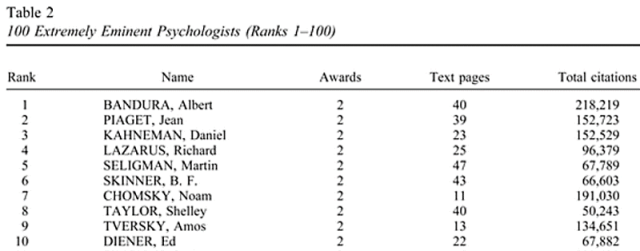
Yet, even if one were inclined to call this a superficial topic this doesn’t automatically mean it’s superficial science. Here’s the thing: I’ve recently stumbled upon a paper listing 200 eminent scholars in psychology, concentrating on people that are still active today or have been publishing in the second half of the 20th century (thereby excluding “forefathers” such as Sigmund Freud). The ranking was determined by aggregating several indicators, such as number of citations, coverage in introductory psychology textbooks, and prestigious awards received. Here’s a screenshot of the top 10:

Eminent_Psychologists

At No. 1, we see Albert Bandura who is most renowned for this research on self-efficacy, the scientific equivalent of the popular notion “If you believe you can do it, you can do it”. Now, Bandura created most of his work before the onset of modern Positive Psychology, but he clearly has a big influence on the field.

At No. 3, we have Daniel Kahnemann, Nobel Laureate of 2002 who, together with his late partner Amos Tversky (No. 9), has developed prospect theory. I´ve been told that Kahneman does not like being called a Positive Psychologist. Nevertheless, he´s the lead editor of the seminal book Well-Being: Foundations of Hedonic Psychology which, by all means, makes him an important contributor to the field.

At No. 5, we have Martin Seligman himself – no explanation necessary.

At No. 8, we find Shelley Taylor, who most likely would not be characterized as a Positive Psychologist. Still, she has made some influential contributions on the subject of optimism and its relation to psychological well-being.

And at No. 10, we see Ed Diener, co-creator of the prominent Satisfaction With Life Scale and major contributor to the fields of subjective wellbeing and public health.

I guess this pretty much settles the score. 🙂

Relational Energy: Is your Organization fully charged? 

SONY DSCAre you fully charged right now? Do you feel energized? Full of zest? Or do you feel de-energized? Depleted? Run-down? Or maybe something in-between?
No matter what it is that you´re currently experiencing – it´s clear that humans tend to describe their condition in terms of energetic states. What is this energy? It is clear that we’re not talking about energy in a (strictly) physical sense. Yes, we may feel drained energetically because of a lack of food (especially carbohydrates), and definitely a lack of sleep – and we do feel recharged after eating or taking a nap. But with the kind of energy we´re talking about here, there´s more to it.

By way of example, taking a brisk walk after lunch can restore our energy and help us being more productive in the afternoon, even though a lot of physical energy is actually spent while moving.

Moreover, human energy feeds on interesting ideas, on passion, on having a goals, especially shared goals. Research shows the same activity can be energizing or de-energizing, depending on the question if that activity plays to our strengths – or if it autonomously regulated (by and large: intrinsically motivated) or externally regulated (forced upon us). A great of overview of different frameworks of human energy is given in: Quinn, R. W., Spreitzer, G. M., & Lam, C. F. (2012). Building a sustainable model of human energy in organizations: Exploring the critical role of resources. Academy of Management Annals, 6(1), 337-396.

But most importantly, our energy feeds on interaction with other human beings – yet, it can be drained during that process as well.

Relational Energy

For a moment, think about a typical interaction with a colleague at work. Depending on the quality of that interaction, afterwards you might feel:

  • (a little) elevated/uplifted (= energized);
  • (a little) depleted/exhausted (= de-energized);
  • just as before (= unchanged).

In reality, depending on the quality of past experiences, this process might start well before the actual interaction, precisely when a person starts to think about having to meet with another person. I mean, honestly, how often do we say something along the lines of: “Oh gosh, I have a meeting with X tomorrow – I wish I could send someone else…”

This is the reason why a lot of companies start to adopt a “no-asshole-policy”: They adjust their hiring/firing processes in order to minimize the occurrence of “emotional black holes” among their employees, those people that suck up the energy of their colleagues, even when they are high-performers within their respective domain of work. The damage they cause to the organizational network by far outweighs their productivity in the long run (please check out: Cross, R., Baker, W., & Parker, A. (2003). What creates energy in organizations? MIT Sloan Management Review, 44(4), 51-57).

Now, imagine how many encounters you have on an average day at work, be they short and fleeting (e.g., small talk at the water cooler) or extended and intensive (e.g., a day-long workshop). And now go on to imagine all the people in your company, and their encounters over a day, or a week, or a year.

With a large company, e.g., the one I work for (120.000 employees), we’re easily talking about more than a billion of those interactions per year. That’s more than one billion occasions to either charge or discharge the energy of that organization. Each energetic transaction may be minuscule, but together they form the most important asset of that organization (besides such aspects as the properties, machines, trademarks). Because here’s the thing (and you know this very well from your own life): The energetic state of each employee is connected to a lot of outcomes, such as work engagement, creativity, and satisfaction – and taken together, alles those interactions form a larger part of the organizational culture.

When we´re talking about “change”, usually we´re referring to big fluffy concepts: “change the culture”, or “change leadership”. But can we really work with those entities in real life? Isn’t it more advantageous to start with the little things, the day-to-day behavior? In order to do that, we´d have to be able to measure the nature of those interactions with regard to their “energetic quality”.

Such an attempt has now been made by a team of US-based researchers (Owens, B. P., Baker, W. E., Sumpter, D. M., & Cameron, K. S. (2016). Relational energy at work: Implications for job engagement and job performance. Journal of Applied Psychology, 101(1), 35-49). They define (positive) relational energy as

a heightened level of psychological resourcefulness generated from interpersonal interactions that enhances one’s capacity to do work.

The researchers propose a new scale for the measurement of this kind of energy from the vantage point of the recipient; these are two of the items they propose:

  • I feel invigorated when I interact with this person.
  • After interacting with this person I feel more energy to do my work.

Large companies usually go to great lengths in order to measure employee engagement, satisfaction, and related psychological states. Now imagine having each employee in an organization fill out a short questionnaire on the relational energy they’re getting out of interacting with their closest co-workers, managers, and subordinates. This, in turn, could be used to create a detailed “energetic map” of that organization, thereby identifying the energizers and the “black holes” along the way.

I imagine this could lead to a complete new, data-based paradigms in leadership development.

Honoring the Forefathers: Abraham Maslow and the Quest for Self-Actualization

Abraham_MaslowA couple of days ago, I shared some memorable quotes coined by Viktor Frankl whom most people consider to be the biggest influence on research related to meaning in life (and work).
Today, I´d like to honor another luminary, the person who actually coined the term Positive Psychology in the 1950s: Abraham Maslow, probably best-known for his hierarchy of needs framework (mostly depicted as the “pyramid of needs” you´ll find in a lot self-help and management books).

Here are some of his most intriguing thoughts:

Abraham Maslow on Self-Actualization

It looks as if there were a single ultimate goal for mankind, a far goal toward which all persons strive. This is called variously by different authors self-actualization, self-realization, integration, psychological health, individuation, autonomy, creativity, productivity, but they all agree that this amounts to realizing the potentialities of the person, that is to say, becoming fully human, everything that person can be.

—–

We fear our highest possibilities. We are generally afraid to become that which we can glimpse in our most perfect moments, under conditions of great courage. We enjoy and even thrill to godlike possibilities we see in ourselves in such peak moments. And yet we simultaneously shiver with weakness, awe, and fear before these very same possibilities.

Abraham Maslow on Purpose in Life

A musician must make music, an artist must paint, a poet must write, if he is to be ultimately at peace with himself. What a man can be, he must be.

Abraham Maslow on Other-Orientation

The needs for safety, belonging, love relations and for respect can be satisfied only by other people, i.e., only from outside the person. This means considerable dependence on the environment. A person in this dependent position cannot really be said to be governing himself, or in control of his own fate. He must be beholden to the sources of supply of needed gratifications. […] He must be, to an extent, “other-directed,” and must be sensitive to other people’s approval, affection and good will.

—–

The great lesson is that the sacred is in the ordinary, that it is to be found in one’s daily life, in one’s neighbors, friends, and family, in one’s backyard.

Abraham Maslow on Perseverance and Post-Traumatic Growth

Not allowing people to go through their pain, and protecting them from it, may turn out to be a kind of over-protection, which in turn implies a certain lack of respect for the integrity and the intrinsic nature and the future development of the individual.

—–

One can choose to go back toward safety or forward toward growth. Growth must be chosen again and again; fear must be overcome again and again.

Abraham Maslow on Appreciation, Awe, and Gratitude

The most fortunate are those who have a wonderful capacity to appreciate again and again, freshly and naively, the basic goods of life, with awe, pleasure, wonder and even ecstasy.

Abraham Maslow on Mindfulness

I can feel guilty about the past, apprehensive about the future, but only in the present can I act. The ability to be in the present moment is a major component of mental wellness.

Positive Psychology News Digest on Mappalicious | No. 21/2016

My favorite pieces covering Positive Psychology and adjacent from (roughly) the last seven days.

Edge: Misunderstanding Positive Emotion by June Gruber

Scientific American: A Self-Improvement Secret: Work on Strengths by Lauren Howe

NPR: MacArthur ‘Genius’ Angela Duckworth Responds To A New Critique Of Grit by Anya Kamenetz

Smithsonian: If grit breeds success, how can I get grittier? by Emily Matchar

Psych Central: When Grit Falls Short by Robert McGrath

Huffington Post: A Quick Daily Writing Practice That’s Proven to Make You Happier by Izzy McRae

Quartz: Scarcity mindset is a great way to suck creativity and visionary thinking out of your life by Camille Ricketts

Guardian: Money can’t buy happiness? That’s just wishful thinking by Ruth Whippman

Fulfillment Daily: The Rise of toxic Leaders and what to do about it by Ray Williams

Center for Positive Organizations: Logitech named winner of 2016 Positive Business Project, no author

Center for Positive Organizations: Time to overcome your skepticism – Positive business is the future of capitalism, no author

Mappalicious - News Digest